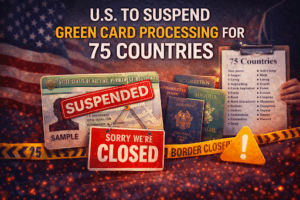
In mid-January 2026, the U.S. Department of State announced an indefinite pause on immigrant-visa (green card) issuance for 75 countries.
The suspension begins on January 21, 2026 and – as official guidance makes clear – will remain in effect “until DoS reassesses its procedures” for screening visa applicants.
The State Department notes that this pause only affects consular processing abroad (applicants seeking visas at U.S. embassies and consulates) – it does not apply to people already in the U.S. adjusting status or to nonimmigrant visas. No end date has been announced.
Which Countries Are Affected?
The Department of State released the full list of 75 nationalities covered by the pause. In alphabetical order, they include: Afghanistan, Albania, Algeria, Antigua and Barbuda, Armenia, Azerbaijan, Bahamas, Bangladesh, Barbados, Belarus, Belize, Bhutan, Bosnia & Herzegovina, Brazil, Burma (Myanmar), Cambodia, Cameroon, Cape Verde, Colombia, the Democratic Republic of the Congo (Kinshasa), Cuba, Dominica, Egypt, Eritrea, Ethiopia, Fiji, Gambia, Georgia, Ghana, Grenada, Guatemala, Guinea, Haiti, Iran, Iraq, Ivory Coast, Jamaica, Jordan, Kazakhstan, Kosovo, Kuwait, Kyrgyzstan, Laos, Lebanon, Liberia, Libya, North Macedonia, Moldova, Mongolia, Montenegro, Morocco, Nepal, Nicaragua, Nigeria, Pakistan, the Republic of the Congo (Brazzaville), Russia, Rwanda, Saint Kitts & Nevis, Saint Lucia, Saint Vincent & the Grenadines, Senegal, Sierra Leone, Somalia, South Sudan, Sudan, Syria, Tanzania, Thailand, Togo, Tunisia, Uganda, Uruguay, Uzbekistan, and Yemen.
Notably, many of these countries are already subject to U.S. travel bans or restrictions. As immigration analysts point out, “many of the above countries are already on either a full or partial travel ban list”.
For example, the list includes nations with full travel bans (like Afghanistan, Iran, Iraq, Libya, Somalia, Sudan, Syria, Yemen, etc.) and partial bans (Cuba, Nigeria, Guinea, Togo, etc.). In practice this means the immediate impact of the visa pause on those nations may be limited, since most applicants would already have been ineligible except in rare waiver cases.
Why Is Visa Processing Being Suspended?
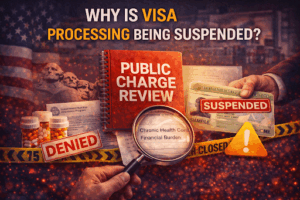
The State Department ties the suspension to its stricter enforcement of the public-charge inadmissibility rule. Under U.S. law, visa applicants who are likely to become dependent on government benefits can be denied entry.
The recent guidance emphasizes that “immigrants must be financially self-sufficient and not be a financial burden” on Americans, and says the department is “undergoing a full review of all policies… to ensure that immigrants from these high-risk countries do not utilize welfare… or become a public charge”.
In other words, consular officers are being instructed to scrutinize applicants more closely for factors indicating potential future reliance on U.S. public assistance.
In fact, in November 2025 the State Department issued a directive dramatically expanding the criteria for public-charge determinations. That cable told consular officers to consider a much broader range of health and other factors when vetting visa applicants.
For example, it lists chronic conditions – diabetes, heart disease, cancer, obesity, mental illnesses, and even the health of an applicant’s non-applicant family members – as negative indicators that an applicant might eventually need public support. It also urged officers to more rigorously examine each applicant’s age, education, skills and finances to predict public-charge risk.
State Department spokespeople have confirmed the link to public-charge policy. As one senior official explained, “the State Department will use its long-standing authority to deem ineligible potential immigrants who would become a public charge on the United States and exploit the generosity of the American people,” and said that “immigration from these 75 countries will be paused while the State Department reassesses [its] processing procedures to prevent the entry of foreign nationals who would take welfare and public benefits.”
In short, the pause gives the State Department time to rewrite its public-charge screening rules before resuming normal visa issuance.
Are Dual Citizens Affected?
No – provided they apply with the passport of a non-suspended country.
The official guidance explicitly exempts dual nationals who use an unaffected passport.
As the State Department notes, “Dual nationals applying with a valid passport of a country that is not listed above are exempt from this pause.”
In practice, this means that if you hold citizenship in one of the 75 countries and another country not on the list, you can still obtain an immigrant visa by applying with the other passport. (Conversely, if you have only the affected nationality/passport, the pause applies.)
How Long Will the Suspension Last?
The pause is open-ended. The Department has not set a fixed end date. According to the official announcement, the suspension will stay in place “until DoS reassesses its procedures for determining whether immigrant visa applicants from these countries are likely to become financially dependent on the U.S. government and, therefore, deemed inadmissible on public charge grounds.”
𝐀𝐭 𝐭𝐡𝐢𝐬 𝐭𝐢𝐦𝐞 there is “no announced end date for the pause,” meaning it will continue indefinitely until the new screening rules are finalized.
In practical terms, Congress or a future administration would need to lift the pause or issue new guidance before any visas can be issued again.
When Does the Suspension Take Effect?
The policy takes effect January 21, 2026.
Any immigrant visa interview scheduled on or after that date for a national of one of the listed countries will result in visa denial until the pause is lifted.
The announcement was first made on January 14, 2026 via X by DoS, and quickly confirmed by formal guidance.
The State Department has stated that applicants from the 75 countries may still schedule and attend their interviews, but consular officers will simply refuse to issue the visa during the suspension period.
Importantly, existing visas and green cards are not being revoked by this rule. If you already hold an immigrant visa or lawful permanent residence, this announcement does not invalidate it. The pause only applies to new immigrant visa issuances from the affected nationalities.
What Applicants Should Do
Applicants from the affected countries should stay alert for updates.
While you cannot receive a green card until the pause ends, you should continue to prepare your case: submit required documents and attend your consular interview as scheduled, because the State Department will continue processing applications up to the point of issuance.
It’s also wise to consult an experienced immigration attorney. We can help clarify how this policy affects your specific case and advise on alternatives (for example, applying via a different nationality or converting to a nonimmigrant status if possible).
Key Takeaways: Visa processing for 75 mostly-foreign nationalities will be halted starting Jan 21, 2026, while the U.S. retools its public-charge rules. Many of the listed countries already have travel bans. The suspension is indefinite (no end date set yet).
Only immigrant (green card) visas at consulates are affected; nonimmigrant visas and adjustment-of-status cases in the U.S. are not impacted. Dual citizens with another country’s passport are exempt. Applicants can still file and be interviewed, but no visas will be issued until the pause ends.
The Law Offices of Anne Z. Sedki
If you or a family member are affected by this new policy, our team is here to help.
The Law Offices of Anne Z. Sedki is a full-service U.S. immigration law firm with offices in Garden City, NY and Jersey City, NJ. We handle green cards, family and employment visas, asylum cases and more.
To discuss your case and next steps, please contact us for a consultation. Call +1 (516) 276-9143 or visit our website to schedule an appointment.
Our offices regularly publish updates on immigration developments – check back often for the latest information.