The U.S. government has expanded its travel ban from 19 countries (announced in June 2025) to a total of 39 countries, effective January 1, 2026.
President Trump’s Dec. 16, 2025 proclamation “expands on” the June 4, 2025 ban, continuing restrictions on the original 19 countries and adding 20 more. The administration says the newly affected nations exhibit “demonstrated, persistent, and severe deficiencies in screening, vetting, and information-sharing”.
In short, the goal is to protect Americans from foreign nationals who may pose security risks or “who intend to commit terrorist attacks, threaten our national security,” or exploit U.S. immigration laws.
As in the previous proclamation, the policy draws a clear line between full suspensions (no entry at all) and partial suspensions (blocking immigrants and some visa types).
Both the June and December proclamations cite federal authority under INA § 212(f), which gives the President power to “suspend the entry of all aliens or any class of aliens” deemed harmful to U.S. interests.
Courts have generally upheld this authority. In fact, the Supreme Court in Trump v. Hawaii (2018) found the earlier travel ban was “squarely within the scope of Presidential authority” and aimed at “preventing entry of nationals who cannot be adequately vetted”. (We’ll return to possible legal challenges below.)
Countries Subject to Full Travel Ban
- Initial (June 4, 2025 list, 12 countries): Afghanistan; Burma (Myanmar); Chad; Republic of the Congo; Equatorial Guinea; Eritrea; Haiti; Iran; Libya; Somalia; Sudan; and Yemen. These countries were fully barred from entry (no immigrant or nonimmigrant visas).
- Newly added (Dec. 16, 2025 additions, 7 countries): Burkina Faso; Mali; Niger; South Sudan; Syria. Also, Laos and Sierra Leone – which were on the partial list in June – have been moved to full suspension.
- Other fully banned: Palestinian Authority–issued travel documents are also now fully banned for entry. In other words, any person with a PA passport or travel document is prohibited from visiting or immigrating to the U.S. under this proclamation.
Each of the above countries is subject to total suspension of entry: immigrants and all nonimmigrants (tourists, students, workers, etc.) are barred. No new visas will be issued to these nationals, and those already present should avoid international travel (reentry could be denied).
Countries Subject to Partial Travel Ban
- Initial (June 4, 2025 list, 7 countries): Burundi; Cuba; Laos; Sierra Leone; Togo; Turkmenistan; Venezuela. In June 2025, nationals of these countries could not receive immigrant visas, and certain nonimmigrant visas were curtailed. (Notably, Laos and Sierra Leone have now been upgraded to full ban status.)
- Newly added (Dec. 16, 2025 additions, 15 countries): Angola; Antigua and Barbuda; Benin; Côte d’Ivoire; Dominica; Gabon; The Gambia; Malawi; Mauritania; Nigeria; Senegal; Tanzania; Tonga; Zambia; and Zimbabwe.
Citizens of partially restricted countries still face significant limits. Immigrant visas are suspended, and nonimmigrant visas in certain categories (B‑1/B‑2 tourist/business, F/M student, and J exchange) are also barred. (For example, student or tourist visas from these countries will no longer be issued.) The proclamation directs U.S. consulates to sharply limit the validity of any other nonimmigrant visas they do issue.
When the Travel Ban Takes Effect
The expanded travel ban becomes effective January 1, 2026. Any foreign national from a covered country who is abroad on Jan. 1, 2026 (at 12:01 am EST) without a valid U.S. visa will be barred from entering.
Existing valid visas issued before that date are not automatically revoked, so holders of unexpired visas or green cards may still travel, though they should expect intense extra screening. After the deadline, any new visa applications in the banned categories will be denied.
Scope of the Travel Ban
Under the new proclamation, only nationals of the listed countries (or those with PA travel documents) are affected. The restrictions apply only to those seeking entry to the U.S., not to people already in the country.
Specifically, U.S. officials are instructed to suspend the entry of covered foreign nationals who are outside the U.S. on Jan. 1, 2026, and who do not hold a valid U.S. visa at that time. Nationals of a full-suspension country must simply not travel to the U.S. at all if they lack a visa, while those from a partial-suspension country will be denied visas in the barred categories.
For the 12 (plus 7 new) fully suspended countries, all visa categories are closed. Immigrant visas and all nonimmigrant visas (tourist, student, work, etc.) are barred. For the 20 (7 old + 15 new) partially suspended countries, only immigrants and the B-1/B-2, F, M, and J nonimmigrant classes are blocked. In either case, consular officers have been ordered to shorten the validity of any other visas that might be issued to these nationals.
The proclamation contains no fixed end-date; it directs an interagency review every 180 days to decide if the bans should continue or be modified. In practice, that means the 39-country list could be further adjusted by future proclamations or lifted if the underlying conditions change.
Persons Exempted from the Restrictions
The proclamation itself carves out several categories of travelers who are not subject to the ban:
- U.S. lawful permanent residents (green card holders). They may continue to enter on their green cards.
- Dual nationals traveling on the passport of a non-listed country. (E.g. a dual citizen of an affected country and a visa-waiver country can use the latter passport.)
- Diplomats and certain other official visa holders. Holders of diplomatic or international organization visas are excluded.
- Athletes and accompanying personnel for major sports events. For example, qualifiers for the 2026 World Cup or 2028 Olympics are exempt.
- U.S. government Special Immigrant Visa (SIV) holders. (These are visas for certain foreign employees of the U.S. government.)
- Immigrant visas granted to certain Iranian minorities. (The proclamation explicitly protects minority religious and ethnic groups already persecuted in Iran.)
- Individuals already granted asylum or admitted as refugees. Those who have already received asylum or refugee status may still enter.
- Case-by-case national-interest exceptions: The Attorney General, Secretary of State, and DHS Secretary may waive the ban for individuals whose travel “serves a U.S. national interest”. These waivers are expected to be rare, but they exist for compelling cases.
In sum, green-card holders and those traveling on diplomatic or other protected visas are unaffected. All other travelers should carefully check whether their planned trip falls under one of these narrow exemptions.
Will This Be Challenged in Court?
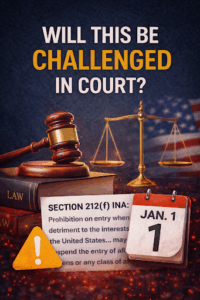
Almost certainly. Civil-rights groups or affected travelers may sue, but courts have generally upheld such bans. The key authority is INA § 212(f), which gives the President broad power to suspend entry of any class of aliens deemed detrimental to the U.S. The CRS report explains that the 2025 proclamation explicitly invokes § 212(f), allowing “the President to suspend the entry of all aliens or any class of aliens” whenever he finds it necessary.
Notably, the Supreme Court has already ruled on an analogous travel ban. In Trump v. Hawaii (2018), the Court upheld President Trump’s original (2017) restrictions. The Court found the policy was “squarely within the scope of Presidential authority” under § 212(f) and that its purpose was “preventing entry of nationals who cannot be adequately vetted”.
That precedent suggests a similar broad presidential ban would likely be upheld again, so long as the stated justifications (vetting failures, security risks, etc.) are shown.
Of course, challengers might raise constitutional claims (e.g. discrimination), but the strong statutory and case-law backing means courts are reluctant to strike down these kinds of national-security measures.
Conclusion
The December 2025 proclamation vastly expands the U.S. travel ban and will affect hundreds of thousands of travelers and visa applicants. It roughly doubles the number of covered countries, particularly adding many African and Caribbean nations.
People from those countries – and their employers – should take immediate steps: check visa expiration dates, apply for extensions now, and be aware of the strict new rules. Courts may review the ban, but the legal authority for such restrictions is well-established.
As always, immigration law is complex and rapidly evolving under this policy, so affected individuals should consult an experienced attorney for guidance.
The Law Offices of Anne Z. Sedki
Anne Z. Sedki is an immigration attorney who closely monitors travel ban policy. If you or your organization have questions about the new restrictions, the Law Offices of Anne Z. Sedki can help explain the rules and prepare your case for any needed visas or waivers.