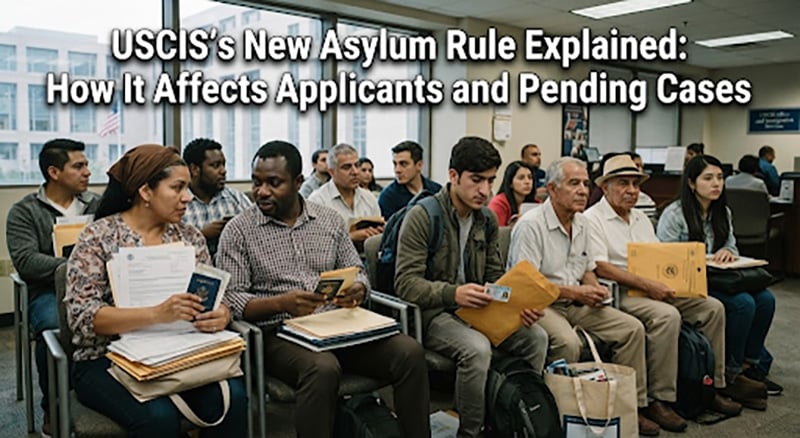
Imagine you filed an asylum application months or years ago and have been anxiously waiting for your USCIS interview and decision. Now picture USCIS announcing a new policy that changes the process.
In late July 2026, DHS introduced an interim final rule that allows USCIS to skip interviews and send some asylum cases straight to immigration court. The goal is to reduce the massive backlog of pending asylum applications. This blog breaks down what the rule does, who it affects, and what applicants need to know to prepare.
What is USCIS’s new rule for reducing the asylum backlog?
Effective immediately (the rule was published July 28, 2026), USCIS will amend its regulations to allow asylum officers to refer certain affirmative asylum cases to the immigration court without first conducting an asylum interview. In plain language, USCIS can now decide that an applicant’s case does not need an interview and send it directly to the Department of Justice’s Executive Office for Immigration Review (EOIR).
Before this change, USCIS generally scheduled an in-person interview for every affirmative asylum applicant (those who filed Form I-589 with USCIS) before making a decision or referring them to court. Now, that interview is not guaranteed.
According to the Federal Register notice, USCIS will still offer interviews for cases that merit one (for example, strong claims needing testimonial evidence), but it explicitly can refer other cases to an Immigration Judge “based on the record and other relevant evidence”. The rule even removes USCIS’s old requirement to include a written credibility assessment in referral letters, simplifying the process.
Why such a drastic change? The asylum backlog has exploded: by the end of FY2025 there were over 1.4 million affirmative asylum cases pending at USCIS. USCIS reports that asylum applicants could wait 7.3 years or longer for a final decision. DHS believes this system “may not be so significant” to require lengthy notice-and-comment delays, and so it issued this procedural rule with an immediate effective date. In short, the new rule is meant to speed up the asylum process by reallocating USCIS resources.
Who Is affected by the new rule?
The rule applies to affirmative asylum applicants– anyone who filed a Form I-589 at USCIS, whether individually or as part of a family. It affects both new applications (filed after July 28, 2026) and pending cases already in USCIS queues. In other words, if you have an asylum case waiting for USCIS decision, this rule kicks in right away.
This policy does not apply to defensive asylum cases (asylum sought as a defense in removal proceedings) or to any other visas or statuses. It’s specifically targeted at the USCIS adjudication of asylum. There are no special carve-outs mentioned for minors or particular nationalities – any affirmative asylum case could potentially be referred without interview.
However, the rule is not arbitrary. DHS expects officers to use it mainly for cases with clear legal bars or extremely weak claims. For example, applicants who filed later than one year after entry (violating the one-year filing deadline) are likely candidates for referral.
DHS estimates about 132,000 future filings per year could be sent to court without interview because of filing bars, other legal bars, or purely discretionary denials. Already, roughly 31% of the 1.43 million pending asylum cases involve late filings (about 444,724 cases) and “may be impacted” by this rule.
In practice, this means an applicant who filed late, has a serious criminal conviction, or otherwise lacks a prima facie case might be routed directly to removal proceedings.
US citizens’ relatives and others not in asylum proceedings are unaffected. And if your case is already in Immigration Court (defensive asylum), it continues under the court’s rules. But if USCIS referred you without an interview, you’ll find yourself in court just as if USCIS had denied your claim.
How the new asylum process works

Here’s a step-by-step look at how affirmative asylum applications will be handled under the new policy:
- File Your Asylum Application (Form I-589): You still start by submitting Form I-589 to USCIS (no changes here). If you’re applying for work authorization (EAD) 150 days after filing, remember other work permit rules are also changing, but that’s separate from the interview rule.
- Initial USCIS Review: After USCIS receives your application, an asylum officer will review the file. Under the new rule, the officer checks if the case falls into a category that can be referred without an interview – for example, one-year bar, other ineligibility, or if on the facts there’s little to grant.
- Referral vs. Interview:
- Referral Without Interview: If USCIS decides a case should go to immigration court, it will send you a notice (often called an NTA, Notice to Appear) referring the case to EOIR without holding a USCIS interview. Your case then moves to the immigration courts.
- Interview: If USCIS does not refer your case outright, they will schedule the usual asylum interview. This happens at a USCIS asylum office, just like before. After the interview, the officer can grant asylum or deny it (in which case a referral to EOIR follows as usual).
- In Immigration Court: Once your case is in EOIR (either by USCIS referral or by USCIS denial after interview), you’ll get a court date. The immigration judge will consider your asylum claim (and any other relief) in a fully adversarial hearing. You can present new evidence and testimony there, but now the Department of Homeland Security will have an attorney opposing your claim.
- Timeline Changes: In theory, skipping some USCIS interviews speeds things up. You may reach the court stage sooner than waiting years for a USCIS appointment. However, note that immigration courts also have long backlogs (averaging multiple years for a hearing). DHS argues this trade-off will still shorten total processing time, especially for strong claims that USCIS will prioritize.
- Administrative Details: USCIS says they will still issue Requests for Evidence or opportunities to supplement your application when needed. If your case is pending and USCIS skips the interview, they might send an RFE first so you can add missing documents or address issues. In any case, you should keep your application as complete as possible from day one, since USCIS officers may rely solely on the filed materials if no interview is conducted.
Will the new rule really reduce the Asylum backlog?
The government’s rationale is that this rule will make the asylum system more efficient. Under the old process, every affirmative asylum case typically got a full interview, even when the outcome seemed obvious.
USCIS observed that many interviews were effectively “duplicative” – for example, asylum seekers barred by law (late filers, aggravated felons, etc.) would still have been interviewed only to be referred for removal afterward. That wasted officer time and delayed resources that could go to potentially grantable cases.
DHS argues that by letting officers skip the interview in clear-cut cases, the agency can prioritize its limited resources for cases that merit protection. The Federal Register summary states that eliminating automatic interviews for ineligible cases “may reduce the growth of the affirmative asylum backlog”.
The expectation is that meritorious applicants will get decisions faster, and those who pose security or criminal concerns can be sent to court (and possibly detained or removed) more quickly.
On paper, the rule could shorten wait times. For example, DHS estimates around 132,000 new asylum applicants per year could be referred without interview under these rules. In those cases, instead of waiting for a USCIS appointment many months away, the applicant goes straight to court where an immigration judge could resolve the case (either granting or ordering removal) faster. Over time, DHS believes this will “increase efficiency” and help stem the growth of the backlog.
That said, it’s important to note a downside. If USCIS refers cases that should have been granted, applicants could face longer delays because they’ll go to court instead of having a USCIS interview.
In FY2021 about 68% of asylum cases originally referred by USCIS to immigration court were ultimately granted asylum by judges. In other words, a large share of those referrals turned out to be valid asylum claims. Some critics worry that skipping the USCIS interview stage could push legitimate cases into a more adversarial process and keep deserving refugees in limbo even longer.
Another concern is that the rule might simply shift the backlog from USCIS to the courts. Immigration judges already have years-long queues, and sending more cases their way might not, in reality, reduce total wait times. And due process advocates argue that each asylum seeker should have a fair chance to tell their story in a non-adversarial setting first. With this rule, that opportunity could vanish for some.
In summary, DHS stands by this change as a necessary efficiency measure. But its effectiveness in practice will depend on how USCIS implements it (which cases get flagged for referral) and whether immigration courts can handle the increase. It’s possible the total time from application to final decision might still be long, even if the case moves into a different queue.
What does this mean for current and future Asylum applicants?
If you have already applied for asylum, your case is now under these new rules. USCIS may review your file and decide to refer it to the immigration court without ever setting an interview date. Keep in mind:
- Stay Alert for Notices: Watch your mail and USCIS online account. If USCIS plans to skip your interview, they should send you a notice (likely a Notice to Appear in immigration court). Read any USCIS communication immediately and follow instructions or seek help if something is unclear.
- Gather and Update Evidence: Because you might not get an interview, it’s more important than ever that your initial application be thorough. Submit as much supporting documentation as you can with your I-589. If you have additional evidence after filing, you can try to submit it or inform USCIS as soon as possible (the new rules suggest USCIS will allow RFEs or supplemental filings to give applicants a chance to present their case).
- Prepare for Court: If your case is sent to EOIR, it will be treated as a defensive asylum case even though you filed affirmatively. This means you’ll go to immigration court with a hearing. You can still apply for asylum before the judge, but the government will be opposing you. Make sure you have an attorney or accredited representative to present your case, gather witnesses if needed, and understand the court process.
- Maintain Legal Status: If you are in lawful status (like a student or worker) while waiting, ensure you keep that status current. If you are on a work permit based on asylum, note that USCIS has also changed asylum-based EAD rules (those changes mean new initial EADs might be paused in future). This blog isn’t about work permits, but you should be aware that the asylum EAD regulations are in flux.
- New Applicants: If you haven’t filed yet but plan to, start as soon as you can. Be mindful of the one-year filing deadline and exceptions to it, since late filing will likely trigger a court referral under the new rule. When you do file, include all relevant evidence up front. And plan for the possibility that USCIS might not interview you; you may need to make your strongest case on paper.
- Seek Legal advice: Given these changes, consulting an immigration attorney is more important than ever. A lawyer can help you determine whether your case is at risk of referral, assist in preparing a complete application package, and represent you in court if needed.
Frequently Asked Questions about the new USCIS Asylum rule
Does this change my pending asylum application?
Yes. If your asylum application is pending at USCIS, the agency will now process it under the new rule. USCIS can choose to refer it to immigration court without an interview. Continue to engage with USCIS normally (respond to RFEs, attend scheduled biometrics, etc.), but be prepared for the referral possibility.
Will I still receive an asylum interview?
It depends. USCIS will offer interviews when they decide one is needed. But they are no longer obligated to interview every applicant. If USCIS thinks your case has clear bars or doesn’t merit grant, they may skip the interview entirely.
Can my case be sent directly to immigration court?
Yes. Under the rule, certain cases will go straight to EOIR. If that happens, USCIS will issue a Notice to Appear in immigration court. Your asylum proceedings will then continue before an Immigration Judge.
Does the new rule increase my risk of removal?
Potentially. In immigration court, the government’s goal is to order removal unless you can convince the judge otherwise. Without a USCIS interview, you lose the advantage of the non-adversarial asylum office process. However, you still have full access to the asylum and withholding process in court. To minimize risk, make sure to apply for work authorization (if eligible) to lawfully stay in the U.S. while your case is pending, and attend every court hearing. Legal representation is crucial in court.
What should I do if I receive a notice from USCIS or immigration court?
Read it carefully and act quickly. If USCIS sends any request (like an RFE or interview notice), comply by the deadline. If you get an NTA from USCIS, you have to attend your immigration court hearing. In both cases, consider contacting an attorney immediately to make sure your rights are protected and your case is presented fully.
Should I speak with an immigration attorney?
Yes. Immigration law is complicated, and these new changes make it more confusing. An attorney (or accredited representative) can explain how the rule affects you, help you gather evidence, represent you in court, and ensure you meet all deadlines. The Law Offices of Anne Z. Sedki has experience with asylum cases and can help asylum applicants nationwide.
Final thoughts
The new USCIS rule is a major shift in asylum policy. It’s understandable to feel anxious if you have a case in limbo. The intention is to speed up the system, but it also means you may move from a USCIS interview to a court hearing sooner than expected. Stay organized: keep copies of all documents, respond to USCIS quickly, and don’t miss any deadlines. Every asylum case is different, so apply these changes to your situation with care.
Remember that laws and rules can change, and the asylum process often has unexpected turns. This blog is for informational purposes and does not replace legal advice. If you have an asylum application pending or are considering applying, keep informed about updates, and do not hesitate to seek legal help to navigate this evolving process.
The Law Offices of Anne Z. Sedki
At The Law Offices of Anne Z. Sedki, we understand how confusing and stressful immigration updates can be. Our firm, based in New York and New Jersey, serves clients nationwide and worldwide.
If you or a loved one have an asylum application pending or need to file one, we are here to help. Our experienced immigration attorneys can review your case under the new rules, advise you on gathering strong evidence, and represent you before USCIS or the immigration court.
Don’t go it alone. Reach out to us for a consultation to discuss your asylum options and next steps. Staying ahead of these changes and having the right guidance can make a big difference in your immigration journey. We’re here to give you the clear answers and support you need during this transition.