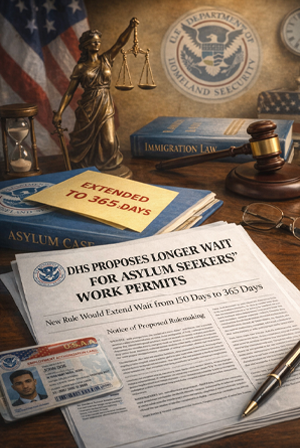
The Department of Homeland Security (DHS) recently announced a proposed regulation that would significantly tighten rules for asylum-related work authorization.
Published in the Federal Register on Feb. 23, 2026, the notice of proposed rulemaking would extend the initial waiting period for asylum-based Employment Authorization Documents (EADs) from 150 days to 365 days.
In plain terms, asylum seekers would have to wait a full year after filing for asylum before they could even apply for a work permit, instead of the current ~5-month minimum.
The proposal also contains a range of other changes affecting who can get an asylum EAD and how those applications are processed.
The main proposed changes include:
- Extended EAD waiting period (150→365 days): Under the current rules, an asylum applicant may file for an initial EAD 150 days after USCIS receives the complete asylum (I-589) application. The new proposal would raise this to 365 days. In other words, an asylum seeker could only apply for a work permit after one year from the date their asylum application was filed.
- New EAD eligibility bars: The rule would add several new eligibility restrictions for asylum-based EADs. For example, it would bar anyone who might be statutorily ineligible for asylum (such as due to certain criminal convictions) from getting an EAD. It would also disqualify applicants whose asylum cases are denied within the first year, those who filed asylum more than one year after arriving in the U.S. (subject to limited exceptions), and those who entered the country illegally and did not seek asylum promptly (with narrow carve‑outs). In short, the EAD eligibility would be aligned very closely with asylum eligibility bars.
- Suspension (“Pause”) of new EAD applications: Perhaps the most dramatic change is a built-in “pause” provision. DHS would have the authority to stop accepting any new asylum‑based EAD applications whenever the average processing time for asylum cases exceeds 180 days. Since USCIS’s current backlogs are already far above 180 days, officials admit that this pause could last “many years” if not addressed. During the pause, no new initial asylum EADs could be submitted until processing times improve below the 180‑day trigger level.
- Termination of employment authorization upon asylum denial: The proposed rule would sharply curtail work authorization when asylum is denied. Under the new terms, an asylum‑based EAD would be immediately terminated if an asylum officer denies the case (unless it is referred to an immigration judge). If an immigration judge denies asylum, the EAD would end 30 days after that decision (unless the applicant appeals). And if a Board of Immigration Appeals denial follows, the EAD ends immediately. This is a much faster cutoff than today’s practice, which generally allows an extra 60 days or until the EAD’s expiration date.
- Longer processing timelines (30→180 days): In addition to the longer waiting period, DHS proposes to give itself more time to adjudicate each asylum‑based EAD. Currently USCIS has only 30 days to process a new (c)(8) EAD application. The rule would extend this allowance to 180 days for any initial EAD filed after the rule’s effective date. (Pending applications filed before the effective date would remain on the 30‑day clock.) The agency argues that the 30‑day window is no longer feasible given security checks and workload, so EAD review would be slowed to a 180‑day maximum.
- Biometrics requirement for all asylum EADs: DHS would require all asylum‑based EAD applicants, including renewals, to submit biometrics (fingerprints and photos) as part of the application. If an asylum seeker fails to appear for their biometric appointment, the EAD application would simply be denied. (Currently, asylum applicants must give biometrics for the asylum case itself, but there is no separate fingerprint requirement for the EAD filing. The new rule would close that gap.)
- Prioritization of asylum cases with derogatory information: Finally, the rule would require USCIS to prioritize the adjudication of an asylum case if, during the EAD review, the agency uncovers any derogatory or criminal information about the applicant. In practice, this means that if an asylum EAD filing flags a background concern, USCIS would move the underlying asylum claim to the front of the line for faster processing.
Each of these proposals represents a significant tightening of the asylum work authorization process. The net effect is that asylum seekers would face much longer delays (and possibly impossibility) in obtaining EADs, while those who do get permits would be more heavily vetted and subject to termination if any issue arises.
Why DHS Is Proposing These Changes

DHS explicitly designed this package of changes to crack down on perceived abuses and backlogs in the asylum system.
The agency argues that the current rules create perverse incentives, because work permits can arrive long before an asylum decision (which on average takes years), some non‑meritorious applicants file asylum primarily to get a permit.
DHS states that the goal is to “enhance benefit integrity, ” protect national security, and reduce strains on DHS resources.
In DHS’s view, the combination of long EAD eligibility, broad criminal bars, and mandatory vetting will “reduce incentives to file fraudulent or frivolous asylum applications” and free up adjudicators to focus on genuine claims.
For example, DHS notes that the average processing time for an affirmative asylum case is currently on the order of 1,278 days (over three years), while work authorization can arrive in as little as 150 days.
With that disparity, “there is little to dissuade an alien from filing an asylum application for the sole purpose of obtaining employment authorization, ” even if the person has little chance of winning asylum.
By making the wait a full 365 days, DHS says it would “deter fraudulent asylum filings” and push applicants toward financial self-sufficiency (reflecting congressional intent).
The new eligibility bars mirror asylum‑statute ineligibilities. For instance, anyone who is likely barred from asylum due to certain criminal convictions would also be barred from an EAD. DHS argues this aligns the rules on criminality and removes loopholes that could let a banned individual work in the U.S. under an asylum application.
Similarly, provisions like enforcing the one-year asylum filing deadline and barring EADs after illegal entry are framed as simply tightening the EAD rules to match existing asylum law.
The “pause” on new EADs directly responds to USCIS backlogs. DHS points out that affirmative asylum receipts have reached historic highs and the asylum backlog has surpassed 1.45 million cases.
Current asylum processing times are well over 180 days, meaning USCIS could never meet that target under present conditions. In fact, DHS itself estimated that if nothing else changed, it might take 14 to 173 years to lower asylum backlogs to a 180-day average.
By giving itself the power to halt new EAD filings during slowdowns, USCIS says it can force a reduction in filings and free up resources. (DHS emphasizes that the pause is automatically triggered by metrics, not discretionary. Only when asylum cases move faster for 90 days in a row would EAD intake resume.)
Extending the processing timeline to 180 days is justified by practical constraints. DHS observes that requiring adjudicators to decide EADs in 30 days is often impossible, especially when extensive background checks and database searches may be needed. The longer clock ensures officers have time to vet applicants without violating the rule.
Mandatory biometric collection is likewise a response to security concerns. DHS notes that, under current practice, officers vet an asylum EAD applicant’s criminal history using the biometrics from the asylum case, but there is no separate fingerprint requirement for the EAD itself.
The new rule would ensure every (c)(8) applicant submits fresh biometrics, making it easier to detect fraud, confirm identity, and uncover disqualifying offenses. According to DHS, this enhances “program integrity” by catching identity fraud and criminal convictions that might otherwise slip through.
Finally, the derogatory-info prioritization is aimed at improving efficiency and security. If an EAD adjudicator spots criminal or fraud indicators in an asylum applicant’s file, DHS wants that asylum case decided quickly. In DHS’s words, finding such information “prioritiz[es] asylum applications for adjudication”.
The idea is that cases posing public-safety risks or clear ineligibility should not languish in the backlog any longer than necessary.
In sum, DHS’s rationale is to tighten the asylum process against abuse and reduce backlog. Officials explicitly say the measures should allow USCIS to devote more resources to meritorious asylum claims and to national security concerns, rather than issuing work permits to anyone who files an asylum claim for the wrong reasons.
How These Changes Would Affect Asylum Seekers and Employers

If this proposed rule becomes reality, it will have major impacts on foreign nationals and on businesses that rely on asylum-based workers. Many asylum seekers would face much longer unemployment or underemployment.
Under the current system, a bona fide asylum applicant can legally work in the U.S. after about 5 months. Under the new rule, even well-qualified refugees would have to wait at least a year before applying for an EAD.
And because USCIS processing could be paused or take up to 180 days once applied, some asylum seekers might not get work authorization for several years.
Immigrant-rights groups and advocates predict harsh consequences. They argue that asylum seekers pushed out of the legal labor market might be forced into the underground economy or become homeless, relying on public assistance while waiting for asylum.
The proposed EAD bars (for criminals or late filers) would also mean that some applicants lose the chance to work even if their asylum case has technical problems, adding financial hardship.
Employers would be affected as well. Thousands of U.S. companies rely on asylum-based work permits (category (c)(8) EADs) to fill jobs, especially in industries like hospitality, agriculture, healthcare, and gig work.
Businesses would need to scramble: HR departments might delay start dates, extend paperwork deadlines, or look for alternate ways to staff positions (other visa categories or temporary labor) if asylum EADs are delayed or frozen.
In practical terms, any employer who currently employs or plans to hire someone on an asylum EAD would need a contingency plan.
This might include identifying which workers could switch to H-2, O-1, or other visas, budgeting for recruitment delays, or even postponing expansion plans.
Employers in states heavily involved in asylum resettlement could face talent shortages, and industries that have become dependent on asylum-seeker labor would likely lobby strongly against the rule.
Overall, the changes would raise costs and uncertainty for both foreign nationals and businesses.
Work-authorized individuals in temporary programs (e.g. those on expiring statuses) could face gaps if they transition to asylum. And foreign nationals who planned to support themselves through work may find they have few legal options under the new rules.
When Would These Changes Take Effect?
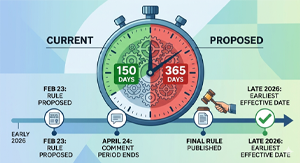
Importantly, none of these proposals are in force yet. DHS has published them as a proposed rule, opening a public comment period.
As of this writing, comments are due by April 24, 2026. After the comment period closes, DHS will consider feedback, finalize the rule, and set an official effective date. In past practice DHS usually waits 30–60 days after the final rule is published before it takes effect.
Thus, the earliest this could become binding law would likely be late 2026 (allowing for final rule drafting and a brief implementation lag).
Until then, the current rules remain in place. In other words, asylum seekers can still apply for EADs 150 days after filing, USCIS still has a 30-day (plus 150-day wait) clock, and no work authorization freezes are in effect.
Anyone eligible under the current system should be aware that this may change soon, however, and plan accordingly
What This Means for You

If you are an asylum applicant or an employer of asylum seekers, you should take proactive steps now.
For asylum seekers, it’s important to realize that if the rule is finalized as written, the longer waiting period would apply only to applications filed after the effective date.
Any asylum-based EAD application submitted before the final rule takes effect would still be governed by the old 150-day rule.
In fact, we recommend that eligible applicants file for their asylum EAD as soon as they reach 150 days from filing, before the rule is finalized.
If you submit your work-permit application before the rule is finalized, you should still be able to receive your work permit. If you wait until after the rule is finalized, you will probably not be allowed to apply at all. In other words, act early under the current rules because the door could close pretty soon.
Employers should also use this time to audit their workforces. Identify any employees or candidates who hold (or plan to apply for) asylum-based work permits.
Consider alternative visa strategies for key workers, or plan for possible gaps. Human-resources teams may need to coordinate with immigration counsel to explore other visa categories (H-2B, TN, O-1, etc.) or temporary staffing if EAD issuance is delayed.
It would also be wise to document any reliance on asylum EADs in hiring plans and be prepared to comment on the rule. In the comment period, business groups and workforce agencies are expected to weigh in heavily on behalf of their members.
In any event, no changes happen overnight. We anticipate the rule could be litigated and contested before it ever takes effect. But uncertainty in the interim can be managed by careful planning.
If you are concerned about how these proposals affect you or your employees, the best course is to seek expert guidance now.
The Law Offices of Anne Z. Sedki
The immigration attorneys at the Law Offices of Anne Z. Sedki are tracking these proposed changes closely.
If you have questions about filing for asylum or work authorization, or how to protect your ability to work and hire, our team can advise you on the current rules and any updates.
We are licensed and authorized to practice U.S. immigration law, and we routinely help individuals and employers navigate complex issues like asylum, visas, and EADs.
Contact us to discuss your situation and take the next steps. We offer consultations on asylum/refugee cases, work visas, and all related immigration matters.
Note: This summary is based on the DHS Notice of Proposed Rulemaking and related analysis as of early March 2026. It is not legal advice. For personalized assistance, please consult an immigration attorney.