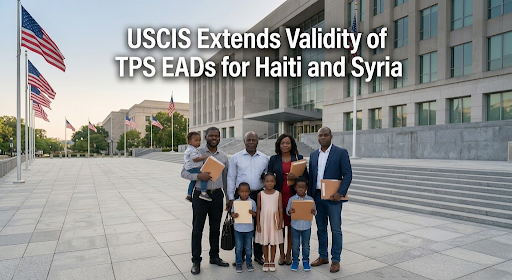
USCIS has just announced a brief extension of work permits (EADs) for Haitians and Syrians holding Temporary Protected Status. Any TPS-based EAD for Haiti or Syria that was set to expire will now remain valid through July 10, 2026.
This comes on the heels of the Supreme Court’s June 25, 2026 decision in Mullin v. Doe, which allowed the government to go ahead with plans to terminate TPS for Haiti and Syria. Until the courts fully sort out the litigation, USCIS is treating Haitian and Syrian TPS beneficiaries’ existing employment authorization as extended to that July 10 date.
Background to this extension
Originally, DHS had slated Haiti’s TPS to end on February 3, 2026 and Syria’s on November 21, 2025. Both termination plans were immediately challenged in court.
In early February 2026 a U.S. District Judge in Washington, D.C., issued a stay blocking Haiti’s termination, which meant Haitian TPS holders kept living and working lawfully past the February cutoff. Similarly, in November 2025 a New York court postponed the termination of Syria’s TPS, delaying what would have been the Nov. 21, 2025 deadline.
Both lawsuits eventually reached the U.S. Supreme Court, which on June 25, 2026 held that TPS terminations are largely not subject to judicial review and lifted the stays. In Mullin v. Doe, a 6–3 majority affirmed that courts cannot enjoin DHS’s decision to end a TPS designation, even on constitutional grounds. In practice, that means the prior court orders that had paused the TPS terminations no longer block DHS from moving forward.
Why USCIS is extending TPS work permits
Because the litigation is still pending, USCIS has effectively told employers and beneficiaries that the TPS holders get a “brief reprieve.”
In a July 1, 2026 USCIS notice, the agency explained that it had been using a generic July 1, 2026 expiration on TPS EADs (“placeholder” dates) while litigation was unresolved. Now, USCIS has deleted the old placeholder date and set July 10, 2026 as the new EAD expiration date for all current TPS-based work permits for Haiti and Syria. In other words, until July 10th, employers should treat those EADs as valid.
The official guidance stresses that this is limited relief pending the outcome of the court cases. USCIS has reminded everyone to “check the USCIS TPS Haiti (or Syria) webpage regularly for updates,” since the July 10 date could change if judges act. For now, however, the beneficiaries’ work permits have been extended by rule of court.
When do TPS designations and work authorization expire?
As of the July 1 notice, the EADs are now valid through July 10, 2026. That is not a final, permanent expiration – it’s a placeholder extension. If the courts ultimately side with DHS on ending TPS, USCIS could allow the EADs to expire on that date (or set another one). If a court restores the stays or vacates DHS’s termination decisions, the EADs could be extended further. For the moment, no Haitian or Syrian TPS EAD will expire before July 10, 2026.
The July 10 date is reflected in USCIS guidance and in I-9/E-Verify instructions. USCIS has advised employees and employers that “July 10, 2026”should be entered as the expiration date on Form I-9 and in E-Verify. (The employee may write “as per court order” or similar wording in Section 1.) Until that date, Syrian and Haitian TPS recipients continue to enjoy protected status and lawful work authorization.
Which TPS EAD categories are affected by the extension?

The USCIS extension covers the TPS work permits (Form I-766) themselves. In practical terms, this means:
- For Haiti: Any Haitian TPS beneficiary holding an EAD (Form I-766) with category code A-12 or C-19 now has that EAD valid through July 10, 2026. These are the codes used for Haiti’s original and redesignated TPS.
- For Syria: Similarly, Syrian TPS EADs (which also bear the TPS category A-12, and sometimes C-19 if applicable) are treated as valid through July 10, 2026.
In short, if your EAD card says it’s for TPS Haiti or TPS Syria (with the usual category codes), you’re covered by this extension. USCIS has instructed that “TPS Haiti beneficiaries will keep their status and employment authorization” and any valid EAD they hold is extended. The same logic applies to Syria’s TPS beneficiaries.
What the TPS extension means
The upshot of this extension is straightforward: Haitian and Syrian TPS holders can keep working through at least July 10, 2026. There is no gap in work authorization until that date. All other benefits of TPS – like being protected from removal and eligible for certain government benefits – remain in place for now (the Supreme Court did not cancel TPS immediately, it only refused to block its termination).
For employees, this means:
- You do not need a new EAD or re-verification yet. Your current EAD is still valid.
- You can remain legally employed, receive paychecks, and use that EAD for I-9 verification up to July 10, 2026.
- Make sure to keep your TPS application and EAD documentation in order and respond promptly if USCIS or DHS sends any notices.
For employers, USCIS’s I-9 guidance tells you to treat these extensions like a court-ordered continued authorization. Specifically:
- In Section 2 of Form I-9, record “07/10/2026” as the new expiration date for the EAD.
- In Section 1 or the Additional Information field, you can note “TPS EAD extended per July 1, 2026 USCIS guidance.” This shows that you are following the temporary rules.
- For E-Verify (in the states that use it), enter the expiration date as 07/10/2026. The system will accept it as valid.
- Do not terminate an employee just because their original EAD date passed – under this guidance their work permit is still valid. Continue to pay TPS workers and provide benefits as usual.
In effect, USCIS has told employers that Haitian and Syrian TPS workers “remain employment-authorized” while this litigation plays out. Think of the extension as giving everyone time to plan for whatever comes after July 10. Until then, these employees are legal, and no new I-9 paperwork is needed beyond the date change. Employers should still be ready for any further updates – but the key takeaway is that no one loses their work authorization before the new July 10, 2026 date.
Employer Checklist
| Task | Action Item |
| Verify EAD Status | Check TPS employees’ EAD cards. If they have TPS category codes (A-12/C-19) and were expiring on 7/1/2026, treat them as valid through 7/10/2026. |
| Update I-9 Records | In Form I-9 Section 2, write “7/10/2026” as the EAD expiration date. In the Additional Info, note the USCIS extension guidance. |
| E-Verify Entry | When creating or updating an E-Verify case, input 07/10/2026 as the expiration date as instructed. |
| Retain Documentation | Keep a copy of the USCIS TPS extension notice or save links to it. Attach it or make a note in the employee’s I-9 files. |
| Monitor Updates | Continue watching for court rulings or USCIS announcements. If the July 10 date changes, update records accordingly. |
What happens next?
This July 10 extension is not the end of the story, just the latest development. In the coming weeks and months, the lower courts will respond to the Supreme Court’s ruling. Possible scenarios include:
- No change: The lawsuits might remain open and no court modifies the hold; DHS might finalize termination notices with later effective dates. In that case, TPS status (and work authorization) could indeed end around or after July 10. Beneficiaries should be prepared for that possibility.
- Further litigation: Plaintiffs could seek rehearing or pursue remaining constitutional claims. Any new court orders could prolong the EAD validity again.
- Policy changes: If the Administration decides to legislatively or administratively save TPS again (through extensions, new designations, or special rules), TPS beneficiaries might get longer protection.
For now, we recommend all Haitian and Syrian TPS holders use this extra time to explore alternative options. For example, they might: apply for asylum, seek family-based or employment-based visas, apply for green cards if eligible, or pursue any other immigration benefits that could provide a more permanent status. They should also gather any documentation (marriage certificates, job offers, etc.) that might support such alternative filings.
Nearing July 10, one should be ready to act quickly if TPS is lifted. If EADs expire on that date, TPS holders who cannot change status would lose work authorization and could become removable. USCIS often allows a grace period or voluntary departure period after TPS termination (typically 6 or 12 months), but do not count on more time without a court order or new policy. Stay in close touch with immigration counsel.
Frequently Asked Questions
- Q: Is my TPS still valid after this extension?
A: Legally, your TPS status remains in place for now. USCIS explicitly said Haitian (and Syrian) TPS beneficiaries “keep their status and employment authorization” for the time being. The extension means you should continue to have TPS benefits (work authorization, safety from deportation, etc.) at least through July 10, 2026. - Q: My EAD card expired before July 10—can I still work?
A: If your EAD had an expiration earlier than July 10, 2026, and it falls under the Haitian or Syrian TPS categories (A12/C19), then yes, USCIS treats it as valid through July 10. The government’s guidance is effectively that no covered TPS EAD is invalidated before July 10. - Q: What should my employer put on my Form I-9?
A: Employers should enter 07/10/2026 as your EAD expiration date on Form I-9 (or E-Verify). The employee can write “as per court order” or similar language if needed. This reflects the USCIS guidance that the EAD is extended. - Q: Will the courts change the extension date?
A: Possibly. The July 10 date is what DHS/USCIS has chosen for now, but it depends on the ongoing litigation. If a court reinstates a stay or if DHS voluntarily extends protections again, USCIS could push the date further. Likewise, if the lower courts allow termination to go forward immediately, USCIS could say that July 10 is final. Keep an eye on official announcements. - Q: What should I do in the meantime?
A:Continue working and living as you have been. Use this time to check other immigration paths (asylum applications, family petitions, etc.) and prepare for the possibility that TPS may end. Contact a qualified immigration attorney if you have specific questions – for example, whether you might qualify for a visa, green card, or asylum.
The Law Offices of Anne Z. Sedki

The Law Offices of Anne Z. Sedki, with offices in New York and New Jersey, help immigrants navigate complex immigration issues, including TPS and asylum cases. If you have TPS (from Haiti, Syria, or elsewhere) and need legal advice, our experienced attorneys can review your situation and discuss options.
We understand these fast-changing developments and can help you prepare. To discuss your case or schedule a consultation, please contact our team – our New York and New Jersey offices are here to assist you through this process.