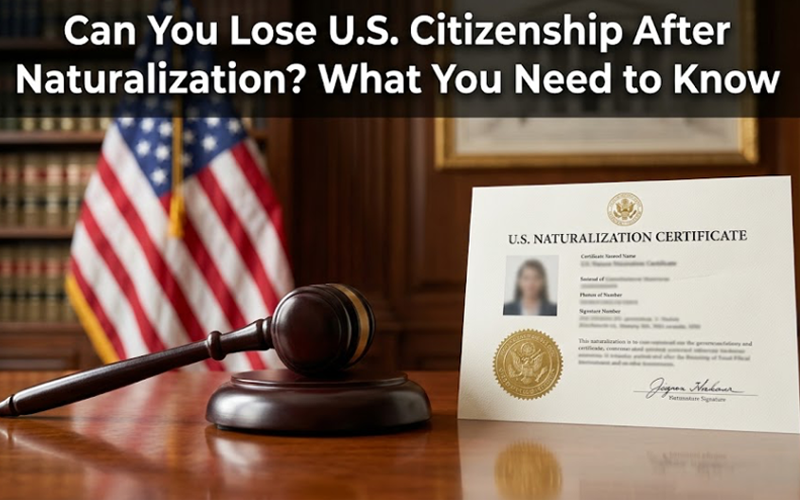
Recent news reports have highlighted a new push by the Justice Department under the Trump administration to strip citizenship from naturalized Americans.
Officials have announced plans to file hundreds of denaturalization cases against people accused of fraud or concealed crimes in their immigration history.
This has raised alarm among immigrants: can your hard-won U.S. citizenship be taken away? The short answer is yes, but only under very specific legal circumstances. This article explains when and how citizenship can be revoked after naturalization, and what protections naturalized citizens have.
Can a Naturalized U.S. Citizen Lose Citizenship?
Yes, but only if the government successfully proves that the naturalization was unlawfully obtained. The key statute is 8 U.S.C. §1451(a), which says citizenship can be revoked (and the certificate canceled) if it was “illegally procured” or procured by “concealment of a material fact or by willful misrepresentation”.
In plain terms, this means the government must show you lied or hid something important on your citizenship application (or committed some disqualifying act) in a way that directly led to your approval.
By contrast, simply being a criminal or paying taxes does not affect citizenship. In fact, experts note that the law sets a very high bar for denaturalization. The courts have explained that citizenship is a “precious” right, so any doubt is resolved in favor of the citizen.
It’s important to distinguish denaturalization from losing citizenship by choice. A person can voluntarily give up citizenship (for example, by formally renouncing it at a U.S. consulate), but that’s a separate, intentional process under 8 U.S.C. §1481, not what we’re discussing here.
We’re focused on involuntary loss – the government stripping someone of citizenship. The only way to lose naturalized citizenship is through an official process called denaturalization – essentially undoing the naturalization order. Unlike a criminal proceeding, it is a civil action brought by the government.
Reasons U.S. Citizenship Can Be Revoked
The law and court decisions list only a few narrow grounds. In summary, citizenship can be revoked if you fraudulently obtained it, meaning:
- Fraud or Willful Misrepresentation on the Application. This is the most common ground. It means you lied about something material when applying for naturalization. For example, claiming you have no criminal record when you do, lying about your marital status, or submitting fake documents. Even omissions can count if they were intentional. Under immigration law, failing to disclose an arrest or criminal conviction can be considered concealment of a material fact. The courts have held that if the lie or omission had a “natural tendency” to mislead officials, it is material. The government must also show that the fraud was what “procured” your citizenship – in other words, that without the lie you would not have been eligible at that time. (If you truly were eligible despite an innocent mistake, you may have a defense against denaturalization.)
- Concealment of Material Facts (Intentional). This overlaps with the above but emphasizes hiding information. For example, if you were convicted of a crime before naturalization but deliberately failed to mention it on your application or during the interview, that can be a basis for denaturalization. Immigration law treats someone who “conceals” such facts as having illegally procured citizenship. Again, the omission must be willful and about something material to eligibility.
- Procurement Through Fraudulent Marriage or Documents. If your citizenship was obtained as a result of a sham marriage or fraudulent immigration paperwork, that is inherently fraudulent. For instance, if you only got permanent residency or citizenship because of a fake marriage, the government can challenge that entire process as fraud. (This would generally fall under the fraud/misrepresentation category.)
- Criminal Convictions Tied to Citizenship Fraud. Separate from the civil process, there is a criminal law (8 U.S.C. §1425) that makes it a felony to procure someone’s citizenship illegally. If someone is convicted under this law, the conviction itself automatically voids the naturalization. In practice, the government usually proceeds civilly (under §1451) rather than criminally, but it’s an alternate path.
The recent DOJ announcements have highlighted cases involving very serious allegations – for example, individuals accused of war crimes, terrorism, sex offenses, or other major crimes that were not disclosed on their applications. These fit the criteria above (falsehoods or concealment). But under current priorities, even less dramatic fraud can be targeted. Ultimately, the revocation process is meant for unlawful procurements of citizenship.
Does Committing a Crime Automatically Cause Loss of Citizenship?
No – that is a common misconception. Having a criminal record, by itself, does not strip you of U.S. citizenship. Once you are naturalized, you enjoy the same legal protections as other citizens, including protection against punitive loss of citizenship simply for bad conduct.
For example, being convicted of theft, assault, or even murder after naturalization does not automatically revoke citizenship. In fact, U.S. law lists only a few very specific actions that cause voluntary loss of nationality (such as treason, serving in a foreign army after age 18, or formally renouncing citizenship). Those don’t apply to ordinary crimes.
What matters for denaturalization is whether there was fraud at the time of naturalization. If you lied about or hid criminal activity on your immigration forms, that could qualify. But a crime committed after you became a citizen won’t retroactively invalidate the Oath you took, unless it reveals you were never eligible in the first place.
Denaturalization cases have historically been “rare” and the law imposes a high bar for revoking citizenship. Courts require the government to prove fraud by clear, convincing, and unequivocal evidence, a much higher standard than normal civil cases. In practice, only deliberate and material misstatements or illegal acts connected to the naturalization process will trigger it.
How the Denaturalization Process Actually Works

If authorities believe someone obtained citizenship unlawfully, the process moves step by step:
- Investigation by USCIS or DHS. Usually, the State Department or U.S. Citizenship and Immigration Services (USCIS) will discover the issue. This might come from a tip, new evidence, or review of the person’s file. USCIS has a small Denaturalization Division that evaluates cases of suspected fraud or concealment.
- Referral to the Justice Department. If USCIS finds credible evidence that naturalization was procured illegally, it refers the matter to the U.S. Department of Justice (DOJ), specifically the Civil Division or a U.S. Attorney’s Office.
- Filing a Civil Complaint. Unlike a criminal trial, denaturalization is generally a civil action. The DOJ files a “Complaint for Denaturalization” in the federal district court where the person lives. The complaint must be filed “upon affidavit showing good cause” that citizenship should be revoked. Essentially, the government lays out its evidence and legal basis under 8 U.S.C. §1451.
- Formal Court Proceedings. Once the complaint is filed, a judge will schedule a hearing or trial similar to other civil cases. The naturalized citizen (defendant) is entitled to notice, a chance to respond, present evidence, and cross-examine witnesses. The Department of Justice essentially acts as the plaintiff. Because citizenship is at stake, the judge usually carefully reviews the evidence. As mentioned, the government bears the burden of proof by clear and convincing evidence.
- Clear and Convincing Standard: This means the facts must be highly probable and not in doubt. It is a strong standard requiring solid documentation (certificates, sworn statements, criminal records, etc.).
- Criminal Proceedings (Alternate Path). In some cases, the government may choose a criminal route by indicting the person under 18 U.S.C. §1425 for procuring citizenship illegally. If convicted in criminal court, the law treats the conviction as automatically revoking citizenship. In such a criminal case, the defendant has the usual criminal rights (though no guaranteed lawyer), and any appeal would follow the criminal process.
- Final Court Decision. If the judge (or jury, if one is used) is convinced the citizenship was obtained illegally, the court will enter an order of denaturalization. This order cancels the person’s Certificate of Naturalization and declares the individual is no longer a U.S. citizen.
The DOJ has made denaturalization a top priority. In June 2025, DOJ released a policy memo instructing its attorneys to “prioritize and maximally pursue denaturalization proceedings in all cases permitted by law and supported by the evidence”.
A year later, DOJ officials announce that they have already filed more cases than in years past and plan to file hundreds more within a few months. Many of these new cases target serious allegations (e.g. undisclosed felonies or terrorism ties), but technically any qualifying fraud case can be pursued under the law.
What Rights Does a Naturalized Citizen Have During the Process?
A person facing denaturalization retains most of the usual legal protections, though it is important to remember this is a civil action. Key points about rights and due process:
- Right to Legal Representation. You can hire an attorney to defend you (and it’s wise to do so). However, there is no right to a government-appointed lawyer in these civil proceedings. You are responsible for your own legal defense if you cannot afford counsel.
- Right to Hear and Be Heard. In a civil denaturalization case, you must receive formal notice (a summons and complaint). You have the right to attend the court hearing, see the evidence against you, and present your own evidence and witnesses. You can challenge the government’s proof of fraud or misrepresentation. The courts emphasize giving the individual a fair opportunity to contest the allegations.
- Burden of Proof on Government. As noted, the DOJ must meet the “clear and convincing” standard. In practice, courts construe any doubtful facts in favor of the defendant. This is an important protection: the benefit of any uncertainty goes to the person whose citizenship is being challenged, not to the government.
- Right to Appeal. If the court orders denaturalization, you can appeal the decision to the Federal Court of Appeals and, ultimately, to the Supreme Court (though Supreme Court review is rare). Any delay in final outcome keeps your citizenship intact until all appeals are exhausted.
What Happens After Someone Is Denaturalized?
If the court finds for the government, the individual’s U.S. citizenship is formally revoked. The Certificate of Naturalization is voided, and the person is no longer an American citizen.
In effect, the person “reverts” to whatever immigration status they had before becoming a citizen. Typically, that means lawful permanent resident (green card) status, if it still exists. The court decision usually specifies the former status.
However, returning to permanent residency does not guarantee staying in the U.S. In many denaturalization cases, the grounds (fraud or a serious criminal issue) are also grounds for deportation. For example, if a green card holder lied about a violent crime to get citizenship, once denaturalized they may be immediately placed in removal proceedings.
So losing citizenship often triggers deportation actions. Even if deportation is not pursued, the person will need to treat any travel documents or permissions as if they were no longer citizens.
Practically, losing citizenship means giving up key rights and privileges:
- You can no longer vote in U.S. elections or hold most public office.
- Your U.S. passport becomes invalid. To travel you would need whatever nonimmigrant or immigrant visa status you’re eligible for.
- Any government jobs or benefits that required citizenship would no longer be available.
- You may face difficulty re-entering the U.S. if you leave.
Importantly, family members are generally not directly affected by one person’s denaturalization. For example, children who are U.S. citizens (by birth or naturalization) remain citizens. Spouses do not lose their own status. (However, if your U.S. citizenship was the basis for a family petition, that petition could be in jeopardy, but that’s a separate immigration matter.)
In short, denaturalization can dramatically alter someone’s life, but it does not create new penalties for innocent relatives. As DOJ officials have emphasized, this power is meant to “maintain the integrity of the naturalization program” by ensuring that people who obtained citizenship unlawfully do not continue to enjoy it. In practice it is a rare outcome, but one with serious consequences for the individuals involved.
Bottom Line: How Naturalized Citizens Can Protect Their Status
For most naturalized citizens, denaturalization is an unlikely scenario. It requires significant deception or wrongdoing at the time of becoming a citizen. Still, in the current environment of increased scrutiny, it pays to be cautious. Here are some practical takeaways:
- Be Truthful on All Immigration Forms.Always provide complete and accurate information when filing for a visa, green card, or citizenship. Even a seemingly minor omission (such as a decades-old arrest) can later be portrayed as material if discovered. Immigration authorities and courts will interpret deceit or willful omissions very strictly.
- Keep Good Records and Documentation.Maintain copies of your naturalization application, application supplements, and supporting documents. If in the future someone questions your case, having documentation can help prove you were eligible. For example, keep police clearance certificates, court dispositions, or other records that show any past issues were lawfully resolved.
- Respond Promptly to Government Notices. If you ever receive a letter or notice from USCIS, DOJ, or ICE about your case, don’t ignore it. Failing to respond or appear at a hearing could default the outcome against you. Always seek legal advice immediately if you get correspondence about denaturalization or related issues.
- Consult an Attorney if You Have Concerns.If you have any doubts about information in your file – for example, you did not disclose something on your form, or you had a questionable sponsor – it is wise to consult an immigration lawyer. An expert can assess your risk, advise whether any remedial steps (like preemptive waivers or clarifications) are needed, and represent you if issues arise. The Justice Department’s current policy encourages aggressive action, but a skilled attorney can also vigorously defend your case.
Remember that the burden is on the government to prove fraud, not on you to prove your innocence. Courts allow defenses such as showing you were in fact eligible for citizenship despite any technical misstatements. If everything in your naturalization application is honest and well-documented, you generally have little to fear – even if the government investigates.
The framers of the Immigration and Nationality Act intended that citizenship would not be taken lightly. Even though the process now garners headlines, denaturalization remains a relatively rare measure that faces high legal hurdles. The best protection is to treat citizenship as the privilege it is, applied for with integrity.
The Law Offices of Anne Z. Sedki
If you have questions about your citizenship status – whether you are applying for the first time or have concerns about the information in your file – our experienced immigration team can help. From offices in New York and New Jersey, we assist clients throughout the United States in all aspects of immigration law, including naturalization, waivers, and denaturalization defense.
We stay up-to-date on federal policies and court cases to give you clear, practical advice. If you’re unsure about how recent denaturalization news might affect you, it’s wise to seek guidance sooner rather than later.
Your citizenship is one of the most important legal protections you have. We’re here to help make sure it stays secure. Contact the Law Offices of Anne Z. Sedki today for a consultation about your situation.