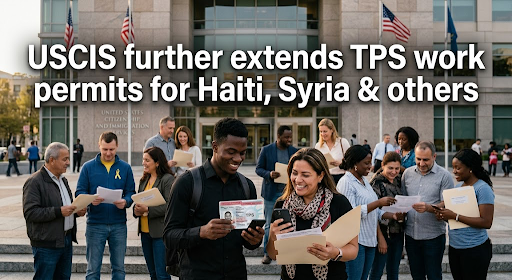
Not long ago, we told you that Haiti’s and Syria’s TPS beneficiaries got an extra two weeks of work authorization through July 10, 2026. We have new news: USCIS has again extended those deadlines—and added several other countries—while litigation continues. Think of it as another short reprieve in a marathon court fight.
This update means many TPS holders can breathe a bit easier for now. Let’s dive into what’s changed and what it means for affected workers and employers.
What’s the new TPS EAD extension?
USCIS just announced that for certain TPS holders, Employment Authorization Documents (EADs) will now remain valid beyond July 10. Specifically, DHS and USCIS have set new expiration dates per the ongoing court orders. Nationals of Haiti, Syria, Burma (Myanmar), Somalia, Yemen, Ethiopia, and South Sudan get extra time.
- Haiti TPS EADs are now valid through July 24, 2026.
- TPS EADs for Burma, Somalia, Yemen, Syria, Ethiopia, and South Sudan are now valid through July 17, 2026.
In practical terms, if you have a valid TPS-based work permit from one of those countries, USCIS has automatically extended it until the dates above. Employers should treat those EADs as valid through July 17 or July 24 (see below) despite what the card says.
Which countries are included?
The automatic extension covers TPS holders from the following designated countries:
- Haiti
- Syria
- Burma (Myanmar)
- Somalia
- Yemen
- Ethiopia
- South Sudan
These match the jurisdictions where federal courts have kept injunctions in place after the Supreme Court’s decision on June 25, 2026 (Mullin v. Doe). Because the TPS termination plans for these countries are still being litigated, DHS gave another brief extension while the courts continue to sort it out.
(Notably, other TPS countries – like El Salvador, Honduras, Nepal, Nicaragua, etc. – are not part of this update, since those designations are ongoing with separate timelines.)
What’s the new expiration date?
Every extended EAD now has one of two new “valid through” dates:
- July 17, 2026 – for TPS work permits from Burma, Somalia, South Sudan, Syria, Yemen, and Ethiopia.
- July 24, 2026 – for TPS work permits from Haiti.
The July 17 date applies uniformly to all listed expiration dates for those six countries, and July 24 for Haiti. (USCIS guidance tells employers to use those dates on Form I-9 and E-Verify for all these beneficiaries.)
Importantly, those dates are not final. They’re placeholders while the lower courts keep hearing the cases. USCIS has described them as “limited relief” until the courts act further. We could see the dates change again, or the programs wind down – so stay tuned.
Who qualifies for the extended work authorization?

The extension applies to anyone who: (1) currently has TPS for one of the above countries and (2) holds a valid TPS-based EAD that would have expired on or before the new dates. In practice, that means:
- Your TPS nationality is Haiti, Syria, Burma (Myanmar), Somalia, Yemen, Ethiopia, or South Sudan; and
- You already had a TPS EAD issued under category A-12 (initial TPS grant) or C-19 (renewal) for one of those countries; and
- That EAD’s original expiration date fell in the window covered by these orders (for example, an EAD dated Feb. 3, 2026, for Haiti, or Sept. 30, 2025, for Syria).
If all of the above are true, USCIS has automatically extended your work authorization through the new date. You do not need to file a new I-765 renewal just because of this extension.
How can I check if my EAD is extended?
You should consult the country-specific TPS pages on the USCIS website, or official updates on I-9 Central and E-Verify. USCIS posted alerts for each country (Haiti, Syria, etc.) on July 10, 2026. Those alerts list exactly which EAD expiration dates are extended and what to enter on the I-9 form.
For example, one USCIS notice instructs employers that for TPS holders from Burma, Ethiopia, Somalia, South Sudan, Syria, and Yemen:
- In Section 1 of Form I-9, write “as per court order” under document expiration;
- In Section 2, put July 17, 2026 with a note like “TPS EAD extension”.
For Haiti, the instruction is the same except you put July 24, 2026 in Section 2. If your employer uses E-Verify, use those same dates in the E-Verify case.
If your EAD’s country and dates match those USCIS lists, that’s how you know it was covered by the extension. If you’re unsure, you can also check with USCIS customer service, an immigration attorney, or an authorized representative.
Next steps for TPS holders (and employers)
Even with this extension, uncertainty remains. Here are some practical points:
- Keep using your EAD. If your current EAD is extended, you can legally continue working through the new date (July 17 or 24). Employers should accept it for Form I-9 and should not terminate employment because of the old printed date.
- Stay informed. This is a moving target. The lower courts may issue rulings soon. USCIS could set yet another extension, or (worst case) end TPS if the injunctions lift. Watch the USCIS website and trusted sources for updates.
- Prepare for contingencies. Think about your long-term plans. If TPS ends, you’ll need another immigration status to stay employed in the U.S. You might explore other visa options (like family-based petitions or work visas), asylum or special visas if eligible, or apply for a green card if possible. Planning ahead can save headaches later.
- Employers should verify carefully.Employers can follow USCIS’s guidance: keep a record of the Form I-9 or E-Verify page showing the extended date and court order note. Avoid forcing employees off payroll unless and until the official guidance changes.
- Consult an attorney if needed. Given the fast pace of changes, having legal advice can be a big help. Lawyers can assess your specific situation (or that of your employees) and suggest what actions to take next.
Remember, TPS itself remains in effect for these countries until the courts finally resolve the termination cases. This extension simply pushes out the work permit expiration a bit.
The Law Offices of Anne Z. Sedki — Here to help

If you or someone you know is a TPS beneficiary from Haiti, Syria, or any of the affected countries and you have questions about your work permit or legal status, we’re here for you. Our experienced immigration attorneys in New York and New Jersey stay on top of these developments every day.
Navigating TPS and its deadlines can be confusing, especially when the rules change quickly. The Law Offices of Anne Z. Sedki has helped countless individuals and families through TPS-related challenges and other immigration issues. Whether it’s understanding the latest USCIS notices or exploring alternatives if TPS ends, we can guide you step by step.
Contact us today for a consultation to discuss your case. We can review your status, explain how this extension impacts you, and outline your options moving forward. Our goal is to give you clarity and confidence — not just today, but for the future of your case.
Stay safe, stay informed, and remember you’re not alone in this process. We’ll continue monitoring all TPS updates closely, and we’ll keep you updated as soon as there’s more news.