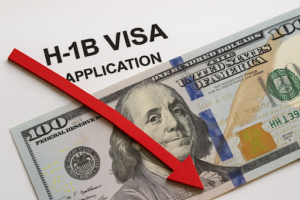
H-1B visas allow U.S. employers to hire foreign professionals in specialty fields (typically STEM– science, technology, engineering and mathematics) on a temporary basis.
Each fiscal year the U.S. grants up to about 85,000 new H-1Bs (65,000 plus 20,000 for holders of U.S. master’s degrees). In FY 2024, USCIS approved nearly 400,000 H-1B petitions (mostly renewals). By law, almost all application costs (filling out forms, paying Labor Condition Application fees, etc.) are paid by the employer.
Under the old rules, employers only paid a few hundred to a few thousand dollars per H-1B petition (for example a $215 registration fee plus filing fees of $1,000–$2,500). But under a new presidential proclamation, the H-1B program is changing dramatically.
What are the changes?
Earlier filing fees totaling a few thousand dollars will be overshadowed by a flat $100,000 surcharge per petition. Starting Sept. 21, 2025 (at 12:01 a.m. ET) a new rule requires a $100,000 payment with every H-1B visa petition.
This is not an extra tax on employees or annual cost – it is a one-time fee per petition. The White House clarified that “this is NOT an annual fee. It’s a one-time fee that applies only to the petition”. In other words, companies must pay $100k each time they file a petition to bring a new worker on H-1B status, regardless of the employee’s salary or skills (exceptions may apply if the Department of Homeland Security deems it in the national interest).
Under the new rule, only new H-1B applicants face the fee. U.S. companies do not owe the $100k again for renewals of existing H-1Bs or for current visa holders re-entering the country.
White House Press Secretary Karoline Leavitt stressed on social media that “this applies only to new visas, not renewals, and not current visa holders.” In practice, the fee will kick in for workers selected in the next H-1B lottery (FY2026) or any cap-subject petition filed after the effective date.
Does it apply to existing holders?
No. The administration was quick to clarify that current H-1B workers are exempt. Leavitt explicitly said H-1B visa holders already in the U.S. (or outside) “will NOT be charged $100,000 to re-enter” and that the fee “applies only to new visas, not renewals”.
In line with that, the proclamation’s text applies only to “aliens who enter or attempt to enter the United States after the effective date”.
USCIS also issued a memo to the effect that the proclamation does not apply to H-1B petitions filed before September 21, currently approved petitions, or individuals holding valid H-1B visas.
In essence, it targets only those seeking brand-new H-1B approvals after Sept. 21, 2025. The Departments of State and Homeland Security will verify payment before issuing such visas.
Why the change?
The White House says the goal is to “level the playing field” for American workers. The administration argues that the H-1B program has been abused by some companies to replace U.S. workers with cheaper foreign labor, especially in the tech sector. By imposing a steep fee, the policy “aims to address the abuse of the program, stop the undercutting of wages, and protect our national security,” according to White House statements.
In other words, supporters contend that most U.S. high-tech salaries far exceed what many H-1B workers accept, and that forcing companies to pay $100k will discourage reliance on cheaper labor. As one administration official put it, “if you have a very sophisticated engineer and you want to bring them in … then you can pay $100,000 a year for your H-1B visa”.
In parallel, the Department of Labor launched Project Firewall on Sept. 19, 2025 – an enforcement campaign “to safeguard the rights, wages, and job opportunities of highly skilled American workers” and to crack down on H-1B visa abuse. Both the fee hike and Project Firewall are sold as steps to protect U.S. workers from unfair competition.
Critics, however, warn this will have broad consequences. Technology companies and immigrant groups say a huge fee jump risks deterring global talent and hurting innovation. Some analyses note it could especially hurt startups and smaller firms that can’t easily absorb million-dollar costs.
But the Trump administration’s position is that this drastic measure is needed to enforce wage standards and prevent program abuse.
When does it take effect and how long will it last?
The new rule became effective September 21, 2025 at 12:01 a.m. ET. In practice that meant H-1B petitions filed on Sept. 21 or later must include the $100k fee. The proclamation is written to expire one year later, on Sept. 21, 2026 (unless extended).
The White House fact sheet notes it will be a 12-month suspension of entry for anyone not meeting the payment requirement, subject to renewal by presidential review. In other words, Congress only approved this as a one-year action, but the administration can recommend and secure extensions if it deems continued restrictions necessary.
Which industries will feel the impact?
Big tech and IT services will be hit hardest. The H-1B program is used overwhelmingly in the technology sector: computer-related occupations alone have accounted for about 60–65% of H-1B approvals in recent years.
Major tech employers like Amazon, Microsoft, Meta and Google routinely have thousands of H-1B workers. For example, in early 2025 Amazon and AWS had over 12,000 approved H-1Bs, Microsoft and Meta over 5,000 each. Meanwhile Indian IT consulting firms (e.g. Infosys, TCS, Cognizant) that send workers to U.S. offices also rely heavily on H-1Bs.
As Reuters summed it up, the fee “could deal a big blow to the technology sector that relies heavily on skilled workers from India and China”. Indeed, stocks of outsourcing giants fell on the news. Any industry that depends on relatively lower-cost foreign STEM talent – including some engineering and finance firms – may need to reconsider hiring plans. On the other hand, fields with fewer H-1Bs (like domestic manufacturing or services) will see little direct effect.
Who holds H-1Bs (nationality)?
By far the largest number are from India. U.S. data show roughly three-quarters of H-1B workers approved in 2023 were born in India. China is a distant second at about 12%. (No other country exceeds 2% individually.) Thus more than 70% of H-1B visas are used by Indian nationals, with most of the rest from China and a handful of other countries.
This distribution is reflected in industry: Silicon Valley and U.S. tech firms employ many engineers from Indian parent companies, for example. Because of this, the fee changes have drawn intense attention in India: that government has publicly raised concerns about the sudden rise in costs causing “humanitarian consequences” for families abroad.
Possible effects and reactions
The immediate effect is a stampede of caution. In practice, news of the fee (and confusion over timing) prompted big companies to urge H-1B employees not to leave the U.S. or to return quickly if abroad. Tech workers on social media reported rushing home on flights to avoid triggering the fee.
Commerce Secretary Lutnick candidly said the change will likely reduce H-1B counts, since “it’s just not economic anymore”.
Economically, adding $100k per visa will mean millions in additional costs for large projects. A company hiring ten new H-1B workers would suddenly owe an extra $1 million. Industry analysts warn this may shift hiring patterns, slow hiring of foreign talent, and potentially push investment (or workers) back overseas.
Some fear it could diminish the U.S.’s edge in attracting top global talent. On the flip side, proponents say the move will force companies to “train Americans” instead and clamp down on wage suppression.
Legally, the fee hike is unusual and likely to face challenges. Labor advocates note that Congress has only authorized fees to cover the cost of processing visas, not to impose a punitive extra levy. Congress may push back, and litigation seems likely. For now, however, the policy stands, and U.S. firms must comply or risk having their H-1B workers denied.
Are there alternatives to H-1B?
Yes. With H-1B harder to get or more costly, employers and workers may look to other visa categories:
- L-1 (Intracompany Transfer): Allows a company to move managers or specialized employees from a foreign office to the U.S. on an L-1A (executive/manager) or L-1B (specialized knowledge) visa. Unlike the H-1B, there is no annual cap, though the worker must have been employed abroad by the same company for at least one year.
- O-1 (Extraordinary Ability): For individuals with “extraordinary ability” in science, arts, education, business, or athletics. This visa has no numerical limit or lottery. It requires a high bar of achievement (awards, publications, etc.) but can be quicker to obtain for standout professionals.
- TN Visa (Canada/Mexico) or E-3 (Australia): Treaty-based visas for citizens of certain countries. TN status (for certain occupations) is available to Canadians and Mexicans under NAFTA/USMCA. E-3 is for Australian nationals in specialty occupations. These have their own rules (e.g. TN often has unlimited renewals, E-3 has a smaller cap of 10,500) and may not cover all fields, but they are common H-1B substitutes.
- Investor/Entrepreneur Visas: Wealthy individuals or companies can consider investor-based visas. The administration has signaled a new “Gold Card” permanent-residency program: foreigners who can pay $1 million (or $5 million for a “platinum” version) would get a fast-tracked green card. This essentially replaces the old EB-5 investor visa with a much higher price tag. For some high-end hires or capital investment, this is a potential path.
- Other options: Specialized trainees might come on a J-1 visa if eligible, or firms might hire remote overseas. (Some U.S. employers also use F-1 student/OPT or H-1B1 visas for Chile/Singapore under free-trade caps, though these too have limits.)
In short, while the H-1B has been the workhorse visa for tech talent, companies will explore L visas, O visas, treaty visas and other categories as needed.
The Law Offices of Anne Z. Sedki
We understand that these developments can be worrying for both businesses and visa seekers. Immigration rules can shift quickly, so staying informed is crucial. We strongly encourage anyone affected by this change – whether an employer or a visa hopeful – to consult an experienced immigration attorney who can explain how the new rules affect you and discuss your options.
At The Law Offices of Anne Z. Sedki, we are closely monitoring these developments and our immigration attorneys stand ready to guide you through the new requirements. We offer employment-based immigration and have guided many businesses and skilled professionals through complex H‑1B and work visa issues.
To discuss your situation or schedule a consultation, please call our Garden City, NY office at +15169636420 or our Jersey City, NJ office at +1-516-487-3831. We welcome the opportunity to answer your questions and guide you through this transition.