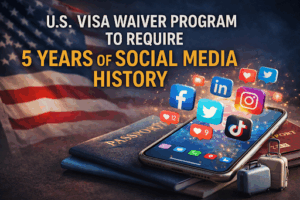
The U.S. Customs and Border Protection (CBP) has unveiled a proposal that would dramatically expand the information required from visa-free visitors.
Under the draft rule, travelers from Visa Waiver Program (VWP) countries – such as the United Kingdom, Germany, Japan, Australia and many others – would have to submit up to five years of their social media history before being authorized to travel to the U.S.
What used to be a simple ESTA application would now transform into a deep dive into a visitor’s digital life.
The Visa Waiver Program
The Visa Waiver Program (VWP) allows citizens of 42 designated countries to travel to the United States for tourism or business for up to 90 days without obtaining a visa. Participating nations include many European countries (such as the United Kingdom, Germany, France), as well as Australia, New Zealand, Japan, Israel, and South Korea.
Travelers under the VWP must have a valid Electronic System for Travel Authorization (ESTA) approval and meet basic requirements (e.g. valid passport, no recent criminal history, and a short-term stay). The ESTA process is automated: applicants pay a small fee and answer eligibility questions online. If approved, an ESTA is generally valid for two years (or until the passport expires) and allows multiple entries, each up to 90 days long.
Otherwise, visitors under the VWP can typically enter with minimal screening – no visa interview is needed, and CBP officers make final admissibility determinations at the port of entry.
Until now, VWP travelers only provided basic biographic data and travel plans. Applicants must attest they do not pose security or health risks, but they did not have to hand over their entire online history. The current ESTA form asks for standard details – passport information, contact info (email, phone), and a few yes/no questions about criminal or immigration issues. In short, the pre-flight paperwork was straightforward.
What are the changes to the program?
The new proposal would overhaul the ESTA application by adding many more required fields. In particular, the plan would make social media information a mandatory part of the form.
For example, CBP’s notice states it will require ESTA applicants to provide “social media from the last 5 years”. In practice, this means every account or username someone has used would have to be listed.
In addition, the proposed updates include a raft of other data collection:
- Social Media (5 years): Visitors would have to list all social media accounts they used in the past five years. This goes well beyond the current optional question on ESTA. Under the proposal, it becomes a mandatory data element.
- Contact History: Applicants must provide all telephone numbers they have used in the last five years and all email addresses used in the last ten years. (That covers any old email or phone number someone ever used.) All of this information would be recorded in the ESTA application.
- Device/IP Data: Travelers will be asked to submit any known IP addresses and related metadata from their electronic photos. In other words, the government could see where a photo was taken or which devices were used.
- Family Background: The rule would expand on the already-required family questions. In addition to family names, the government now wants details like dates of birth, places of birth, residences, and even phone numbers for parents, siblings, spouses and children. All this “high-value” personal data would be collected for immediate family members.
- Biometrics: The proposal explicitly lists biometric information as a new requirement. ESTA applicants may have to supply facial images, fingerprints, iris scans, and even DNA data. This is far beyond anything asked on ESTA today.
- Application Method: The government would also retire the ESTA website option. Travelers would only be able to apply through the official ESTA Mobile app. CBP estimates this change would affect over 14 million annual users of ESTA.
In summary, the changes would turn the ESTA form into a detailed security questionnaire. In practice, this means applicants must account for virtually their entire digital footprint, or risk being denied travel authorization.
Why was this introduced?
The administration says these measures are intended to enhance security by vetting travelers more thoroughly. CBP notes that the rule stems from President Trump’s January 2025 Executive Order 14161, titled “Protecting the United States From Foreign Terrorists and Other National Security and Public Safety Threats.”
To comply with that order, CBP explains it is making social media and other data mandatory on the ESTA form.
In official statements, CBP emphasized the aim is to “keep the American people safe” by improving the vetting process. The agency also frames the proposal as a first step in a broader review of how travelers are screened for U.S. entry.
Critics, however, say the timing and scope point to broader motives. Immigration attorneys have warned the requirement could chill travel and free expression.
Farshad Owji, a former president of the American Immigration Lawyers Association, said requiring social media checks could “chill travel and expression,” causing people to “self-censor” or avoid coming to the U.S. He argued the rule appears designed to assess visitors’ political views (“understand the person’s view of general politics around the world”).
Others note that this fits a pattern: since 2019, all immigrants and non-immigrant visa applicants have had to disclose social media accounts, and student and H-1B visa applicants now even have to make their accounts public. The new rule would extend that scrutiny to millions more travelers under the VWP.
Who is affected by this?
Anyone who would normally travel under the Visa Waiver Program stands to be affected. In concrete terms, this means citizens of the 42 VWP countries who plan short visits to the U.S. for tourism or business (typically up to 90 days). The list of eligible countries includes most of Western Europe, plus places like Australia, Japan, New Zealand, Israel, Singapore and South Korea.
Historically, these nationals could enter the U.S. without a visa by obtaining an ESTA online. Going forward, however, ALL such travelers would need to provide the new data if the rule is finalized.
In addition, anyone who has an ESTA pending or wants to apply soon should take note: the policy does not require that visitors actually upload their social media content, but it does require listing accounts and possibly granting access to details for CBP to review.
Importantly, travelers from non–VWP countries (who already use full visa applications) have long been subject to similar questions. What’s new is extending these requirements to traditionally “visa-free” tourists and business visitors.
When does it take effect?
As of now, it is a proposal, not a final rule. The Federal Register notice (published Dec. 10, 2025) opened a 60-day public comment period on the changes. In plain terms, this means the rule is under review and not in force.
CBP has said that after comments, the changes must still go through the Office of Management and Budget (OMB) and other clearances before taking effect. No official implementation date has been set. Travelers should keep in mind that the policy could be revised or delayed; for now, the ESTA process has not yet changed.
If finalized, CBP estimates the new requirements would begin when the updated ESTA system (mobile app) is launched. But again, that depends on the regulatory process. Interested travelers or stakeholders may submit comments to DHS by early February 2026, after which DHS will decide whether to proceed and when. In short, nothing changes immediately, but the proposal could become reality in the near future.
What this means for you
For individual travelers, the implications are significant. If you are from a VWP country and rely on visa-free travel, be prepared for much more detailed vetting. Instead of a simple online form, you’d soon need to account for years of your online life.
Critics warn this could “scare prospective travelers” and dampen tourism and business visits. You may find yourself having to carefully review which social media accounts to list and what information to share. Privacy concerns are likely to arise, since the government could see a lot of personal content and connections.
On a practical level, it’s wise to start taking inventory of your online presence. Make a list of all social media profiles, email addresses, and phone numbers you’ve used. Some travelers might even consider applying for a regular B-1/B-2 visa instead of using ESTA – U.S. visa applications already ask for social media account information, so the main difference may be in timing and where the questions are asked.
In any case, given how stringent the new requirements are, you should double-check that your social media activity doesn’t contain any problematic content (e.g. violations of U.S. law) that could be used against you. Be honest on the application – failing to list an account that is discovered later could lead to a denial of entry.
Finally, if you plan to travel under the VWP soon, stay informed. Check official CBP or DHS announcements for updates. You may also want to consult with an immigration attorney about how these changes could affect your specific situation. Legal guidance can help ensure you complete the new ESTA form correctly or advise on alternative travel options if the new requirements seem too burdensome.
Conclusion
The Visa Waiver Program has long been a convenient way for citizens of 42 countries to visit the U.S. without a visa. The proposed changes would upend that ease by adding sweeping new disclosure requirements. According to reports, the aim is to bolster security by scrutinizing travelers’ backgrounds more deeply, but opponents fear it will deter legitimate visitors and harm tourism.
At the moment, the proposal is open for comment and has not yet taken effect, so nothing is set in stone. Nonetheless, prospective travelers should be aware that U.S. entry requirements may soon include a thorough review of social media, email and family histories. Being prepared and informed will be key.
The Law Offices of Anne Z. Sedki
The Law Offices of Anne Z. Sedki, specializes in U.S. immigration and travel authorization issues. If you have questions about the Visa Waiver Program, ESTA applications, or how new rules might affect your travel plans, we can help.
Our experienced attorneys provide personalized guidance on preparing your applications and staying in compliance with U.S. entry requirements. Contact us for a consultation to discuss your situation and ensure you are ready for any changes in the U.S. travel process.