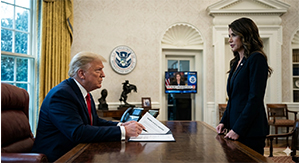
On March 5, 2026, U.S. President Donald Trump announced that he had removed Homeland Security Secretary Kristi Noem from her post, citing months of controversy during her tenure.
In a Truth Social post, Trump said Oklahoma Senator Markwayne Mullin would replace Noem as DHS Secretary, effective by the end of March (pending Senate confirmation).
This makes Noem the first Senate‑confirmed Cabinet member fired in President Trump’s second term. The administration framed the move as a way to “reset” its approach on immigration policy and DHS management.
Noem’s ouster came amid bipartisan criticism over her leadership at DHS. Reports on the firing highlighted several flashpoints: Noem’s aggressive immigration enforcement tactics, her handling of federal spending, and fallout from a pair of controversial shootings by immigration agents.
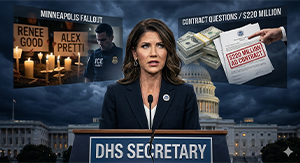
A Reuters summary noted she was dismissed “after months of controversy, including the fatal shootings of two U.S. citizens by federal officers in Minneapolis and lawmakers’ questions over a $220 million advertising contract”. In other words, Trump’s aides have pointed to both policy failures and management scandals as reasons for replacing her.
Reasons for Noem’s Firing
Immigration enforcement controversies: Noem, a former South Dakota governor, was known for carrying out Trump’s aggressive deportation agenda. Yet several high-profile incidents during her year at DHS drew intense scrutiny.
In January, ICE agents shot and killed two Minneapolis residents (Renee Good and Alex Pretti) during a raid. Noem immediately described both victims as “domestic terrorists” – a characterization later contradicted by video evidence and outside observers.
She refused to apologize or retract those comments when questioned by lawmakers, fueling outrage among critics. Minneapolis-area officials and Democrats seized on Noem’s handling of the incident as evidence of mismanagement. (In fact, Noem’s own name became shorthand for the immigration sweep in Minneapolis, which had sparked protests and a government shutdown over DHS funding.)
In Congress, lawmakers of both parties described Noem as a political liability after that episode. Even some Republicans privately anticipated that her role in the Minnesota operation would hasten her exit.
Spending and contract questions: Another major factor was Noem’s stewardship of DHS funds.
In particular, Congress zeroed in on a $220 million DHS advertising campaign that prominently featured Secretary Noem and urged undocumented immigrants to self‑deport. This $220 million contract, awarded without open bidding, drew “rare but blistering criticism” during recent hearings.
Lawmakers were outraged at the cost and the apparent lack of oversight. Noem repeatedly told Congress that President Trump had approved the campaign, but the president later told Reuters he had not signed off on it. That contradiction – played out in public testimony – badly embarrassed Noem.
Members of both parties questioned why so much taxpayer money was spent on an ad campaign that looked political in nature. In short, the ad contract and related spending issues undercut confidence in Noem’s budgetary management.
Political and legislative pressure: Beyond these controversies, Noem also clashed with lawmakers on DHS’s broader agenda. She oversaw a DHS operation in multiple cities that drew protests and violence, and was seen as increasingly defiant of congressional oversight.
During recent Capitol Hill hearings she faced sharp questions not only about immigration policy but also about disaster response and budget issues. For example, some Republicans complained she was slow to disburse FEMA emergency funds after major floods.
Democrats, frustrated with immigration enforcement tactics, had been withholding DHS funding and conditioning it on reforms. With the department partly shutdown, GOP senators privately signaled that they expected Noem’s departure to coincide with an eventual agreement to reopen DHS funding.
Several officials suggested in news reports that a combination of the Minnesota fallout, the ad contract, and alleged personal misconduct had eroded her standing to the point she became more of a liability than an asset.
In sum, DHS watchers see Noem’s firing as the outcome of mounting discontent on Capitol Hill and within the Trump administration over her performance.
Who Is Replacing Noem?

President Trump announced that he will nominate Senator Markwayne Mullin (R-Oklahoma) as the next Secretary of Homeland Security.
Mullin, a two-term U.S. Senator and former Congressman, is a conservative and close ally of the president. In his social‑media announcement, Trump described Mullin as the “highly respected” senator from Oklahoma who will become DHS Secretary.
Trump also said he is grateful for Noem’s service and cited “numerous and spectacular results” she achieved, especially at the border, while moving her to a new role.
Senator Mullin has promised to focus on homeland security. Reporters noted that he told media immediately after the announcement that he is “excited” and “ready to get started” at DHS. He emphasized that his mission will be “to keep the homeland secure”.
If confirmed by the Senate (and the GOP controls the Senate), Mullin will become the head of the third-largest federal agency. Until then, federal law (the Vacancies Act) allows him to serve as acting Secretary once he officially takes over, even before confirmation.
When Will the New Secretary Assume Office?

Trump’s announcement set a clear date: March 31, 2026. As reported by ABC News, the President stated that Mullin “will become the United States Secretary of Homeland Security, effective March 31, 2026”. In practical terms, this means Mullin is expected to take the DHS helm by the end of March.
The Senate will need to confirm his nomination, but White House officials indicated they want to move quickly. In the interim, because of the Vacancies Act, Mullin can serve as acting Secretary as soon as he is formally designated, giving him authority over DHS operations even while awaiting the full confirmation vote.
Until March 31, Kristi Noem officially remains Secretary (even if she is winding down her role), and DHS agencies will continue under her leadership unless the White House appoints an acting head immediately after her departure.
What’s Next for Kristi Noem?

Although Noem is being removed as DHS Secretary, she is not leaving the administration entirely.
President Trump announced that Noem will be named Special Envoy for “The Shield of the Americas,” a new security initiative focused on the Western Hemisphere.
In his announcement Trump praised her record – saying she “has served us well” and had “spectacular results (especially on the Border!)” – and then added that she will take on this new envoy role.
According to the announcement, “The Shield of the Americas” is a planned summit or initiative to reinforce U.S. security partnerships in the hemisphere.
Noem herself has publicly thanked the President for this reassignment. In a post on social media (X), Noem said she is honored by the new role. She wrote that the envoy position will allow her “to build on the partnerships and national security expertise I forged over the last 13 months as Secretary of Homeland Security”.
In essence, the administration is moving Noem from DHS to a diplomatic/security post, signaling that while she will no longer lead DHS day‑to‑day, she will continue to work on Trump’s national security agenda.
Not everyone welcomed the news of her firing and reassignment. Democratic leaders celebrated. House Minority Leader Hakeem Jeffries said on a press call, “Kristi Noem is gone. Good riddance”, echoing other lawmakers who called her tenure a “disaster”.
Minnesota Gov. Tim Walz (a Democrat who clashed with Noem over the Minneapolis crackdown) publicly stated that Noem “has done a stunning amount of damage and it’s good she’s gone”.
Even some Republicans signaled relief. Senator Lindsey Graham (R-S.C.) said Noem had “served our country” and would do well in her new envoy job, but he added that “it was time for a change”.
Regardless of the political debate, the personnel change is set in motion: Noem will leave DHS by late March and Mullin will take her place (subject to confirmation).
The effect will be that DHS’s leadership, especially on immigration enforcement, will have a new face at the top, which Trump’s team hopes will improve relations with Congress and address the problems that critics highlighted.
The Law Offices of Anne Z. Sedki

The Law Offices of Anne Z. Sedki is closely following these developments at DHS. Our immigration attorneys handle a wide range of federal immigration matters, from asylum and visa cases to deportation defense and policy issues.
We know that changes at DHS can affect immigrants and employers alike. If you have concerns about how DHS policy shifts or leadership changes might impact your case or your business, our team can help evaluate your options.
We pride ourselves on listening to each client’s situation and explaining the law in clear terms. Whether you are an individual facing immigration proceedings, an employer relying on DHS processes, or a family wondering about future steps, our firm can guide you.
Contact us for a consultation – we can advise you on any deadlines, possible legal remedies, or next steps in light of evolving DHS policies. Our experienced attorneys will work to protect your rights and help you navigate this complex and changing landscape.