How to Apply for a Green Card: Step-by-Step Guide
Table of Contents
- How to Apply for a Green Card: Step-by-Step Guide
- What Is the Green Card?
- How Do I Get a Green Card?
- Family-Based Green Cards
- Employment-Based Green Cards
- Diversity Visa Lottery
- Humanitarian Pathways
- Investment-Based Immigration
- Other Special Categories
- Where Do I Apply for a Green Card?
- Adjustment of Status (AOS)
- Consular Processing
- What Is the Application Process for a Green Card?
- What Happens at the Biometrics Appointment?
- What Happens at the Green Card Interview?
- How Will I Receive the Decision on My Green Card Application?
- Final Thoughts
- The Law Offices of Anne Z. Sedki
Moving to the United States permanently is a dream many people hold close for years. Maybe you’re hoping to reunite with family, accept a life-changing job opportunity, build a business, or simply create a more stable future for yourself and your loved ones. Whatever brought you here, applying for a U.S. green card can feel both exciting and overwhelming at the same time.
You’ve probably already discovered that the process involves a mountain of forms, government agencies, waiting periods, and unfamiliar legal terms. One minute you feel confident, and the next you’re deep in an internet rabbit hole wondering whether you’re even looking at the right application.
The good news is that the green card process becomes much easier to understand when you break it into clear steps. This guide walks you through what a green card is, the different pathways available, where to apply, what happens during biometrics and interviews, and how USCIS eventually delivers a decision on your case.
What Is a Green Card?
A green card, officially called a Permanent Resident Card, allows a foreign national to live and work permanently in the United States. Once you become a lawful permanent resident, you can legally accept employment, travel in and out of the country more freely, and enjoy protections under U.S. law.
For many people, getting a green card is also the pathway toward U.S. citizenship later on.
According to USCIS, lawful permanent residents may eventually apply for naturalization if they meet eligibility requirements, including residency and good moral character standards.
Some major benefits of having a green card include:
- Living permanently in the United States
- Working legally without needing separate work authorization
- Sponsoring certain family members for immigration benefits
- Accessing some educational and financial opportunities
- Building a long-term future in the U.S.
- Becoming eligible for citizenship after meeting residency requirements
For many families, it represents stability, security, and the chance to finally stop living with temporary immigration uncertainty hanging over their heads.
How Do I Get a Green Card?
The first step in the process is figuring out which immigration pathway fits your situation. Not everyone qualifies the same way, and the requirements can vary significantly depending on the category.
Family-Based Green Cards
This is one of the most common pathways.
U.S. citizens and lawful permanent residents can sponsor certain family members for green cards. Immediate relatives of U.S. citizens generally receive priority treatment under immigration law.
Eligible family relationships may include:
- Spouses
- Parents
- Children
- Siblings
- Fiancés transitioning after marriage
Family sponsorship often begins with a petition filed by the sponsoring relative.
Employment-Based Green Cards
Some people qualify through a U.S. employer.
Employment-based green cards are available for workers with specialized skills, advanced degrees, extraordinary abilities, or job offers from qualifying employers. Certain categories may also require labor certification through the U.S. Department of Labor.
These cases can involve several moving parts, including employer sponsorship, wage requirements, and immigration petitions.
Diversity Visa Lottery
The Diversity Visa Program provides immigrant visas to individuals from countries with historically low immigration rates to the United States.
Each year, the U.S. government selects winners through a random lottery system administered by the U.S. Department of State.
Selection does not automatically guarantee permanent residence, but it allows selected individuals to continue the green card process.
Humanitarian Pathways
Some people may qualify through humanitarian protections.
This can include:
- Refugees
- Asylees
- Victims of trafficking
- Certain crime victims
- Special immigrant juveniles
These pathways often involve additional protections and unique eligibility requirements.
Investment-Based Immigration
Foreign investors may qualify through programs like the EB-5 Immigrant Investor Program by making qualifying investments that create jobs in the United States.
These cases tend to involve detailed financial documentation and strict program requirements.
Other Special Categories
There are also special immigration categories for:
- Religious workers
- Afghan and Iraqi translators
- Certain international organization employees
- Military-related applicants
- Registry applicants
Your eligibility depends entirely on your personal circumstances, immigration history, and supporting evidence.
Where Do I Apply for a Green Card?
Once you pick your category, you need to decide where to apply: inside the United States or outside. The two routes have names.
Adjustment of Status (AOS)
If you are already in the U.S. on a valid visa (or under certain parole programs) and eligible for a green
card, you can apply with USCIS without leaving. This is called adjusting status. Your application is filed with USCIS (using Form I-485, plus supporting forms) and you stay here while it’s processed.
According to USA.gov, “If you are currently in the United States on a nonimmigrant visa, you may be able to stay and apply for adjustment of status”. One big advantage: while your AOS is pending, you can often get work authorization (an EAD card) and even travel permission (advance parole) so life can go on.
Consular Processing
If you’re outside the U.S., you must apply for your green card at a U.S. embassy or consulate in your home country. This is called consular processing. Essentially, once your petition is approved by USCIS, it moves to the Department of State’s National Visa Center, and you attend an immigrant visa interview overseas.
As USA.gov explains, “You may be able to apply for a Green Card from outside the U.S. through a U.S. Department of State consulate. This procedure is known as consular processing”. After the visa is issued, you enter the U.S. and become a permanent resident on arrival.
So, the rule of thumb is: inside the U.S. – adjust status; outside the U.S. – consular processing. (There are some nuances, but as a quick guide, it holds true.)
What Is the Application Process for a Green Card?

With category and location decided, you move into the application mechanics. In broad strokes, the steps are similar for most green cards:
- File an Immigrant Petition: In most cases, someone must sponsor you and file the initial petition. For family cases, a U.S. citizen or green card holder files Form I-130 (Petition for Alien Relative) on your behalf. For employment cases, your U.S. employer usually files Form I-140 (Immigrant Petition for Alien Worker). There are other petition forms too: for example, I-360 covers special immigrants (like certain religious workers, special juvenile immigrants, battered spouses, etc.), and I-526 covers EB-5 investors (though USCIS has updated these rules recently). USA.gov confirms: “Before you can apply for adjustment of status, you or someone else must file an immigration petition for you”. In rare cases (like EB-1 extraordinary ability or VAWA petitioners), you can self-petition, but generally you need a sponsor.
Supporting Documents: The petitioner will need to provide proof of the relationship or job offer. For family, that’s marriage certificates, birth certificates, photos, joint lease, etc. For employment, it includes a job offer letter, your resume, credentials, and a Labor Certification or evidence of the employer’s ability to pay. Each form has its own checklist. The petitioner also usually signs an Affidavit of Support(Form I-864), promising they can financially support you so you’re not a public charge. This means gathering tax returns, pay stubs, and bank statements. - Wait for Petition Approval: USCIS will review the petition and either approve or deny it. If your category is not subject to visa limits (like immediate relatives of U.S. citizens), USCIS will approve, and you move quickly to the next step. If you’re in a capped category, you may have to wait for your “priority date” to become current (check the Visa Bulletin on the State Department website). Once the petition is approved and a visa is available for you, you can proceed.
- Apply for the Green Card (Application Stage): This is where you file the green card application itself. If you’re in the U.S. (adjustment of status), you file Form I-485 (Application to Register Permanent Residence) with USCIS, along with medical exam results, the Affidavit of Support, photos, and any required supporting evidence. You’ll also pay the filing fees and biometrics fee. You’ll send copies of the passport pages, visa, and I-94 admission record. If you’re outside the U.S. (consular processing), you generally wait for the National Visa Center to invite you to submit the immigrant visa application (DS-260) and the same supporting documents, plus attend an interview at the consulate.
- Concurrent Filing: In some cases (like immediate relative cases where the visa is immediately available), a U.S. citizen’s family member can file the petition and the I-485 together. This speeds up the process.
- Work and Travel During Processing: If you apply inside the U.S., you can also concurrently apply for an Employment Authorization Document (Form I-765) and Advance Parole (Form I-131). This lets you work and travel while waiting. Many applicants use this to keep their life moving forward. If you apply from abroad, you usually can’t work in the U.S. until the green card is issued (though you might enter first on another visa if eligible).
Throughout this, keep copies of everything and make sure each submission is complete. Incomplete or sloppy filings are a common cause of delays. (Just ask anyone who’s gotten an RFE – request for evidence! We’ll talk about that next.)
What Happens at the Biometrics Appointment?
After you submit your adjustment of status application (Form I-485) or other application that requires biometrics, USCIS will schedule a biometrics appointment. This usually happens a few weeks after filing. Here’s what to expect:
- Appointment Notice: USCIS will mail you a notice with the date, time, and location (an Application Support Center, or ASC). It will clearly say “Biometric Services Appointment”.
- What They Collect: At the ASC, USCIS will take your fingerprints, photograph, and digital signature. This is used to run background checks (FBI and other agencies) and confirm your identity. It’s a quick process, usually just a few minutes per person. They’ll ask you to reaffirm that the application you submitted is complete and truthful.
- Who Must Attend: Almost all applicants age 14 or older must attend in person. (Children under 14 often do not need to, and applicants over 75 may get some leniency, but they still may ask for a photo.) If your spouse or children (under 21) are included in a family application, they will each get their own appointment notices.
- What to Bring: Bring the ASC appointment notice (Form I-797C) and a valid photo ID (passport, driver’s license, etc.). That’s usually it. They’ll provide the fingerprint ink pad or digital scanner right there. Dress presentably (they will photograph you, which will be on your card or eventually the green card itself).
- How Long It Takes: Plan for about 30–45 minutes at the ASC. It’s not a stressful interview – just biometric collection. They won’t ask anything personal; it’s a routine check.
Think of it as a quick stop where they capture your ID info. Afterward, USCIS has what it needs to check your background, and then they move on to the next steps.
What Happens at the Green Card Interview?
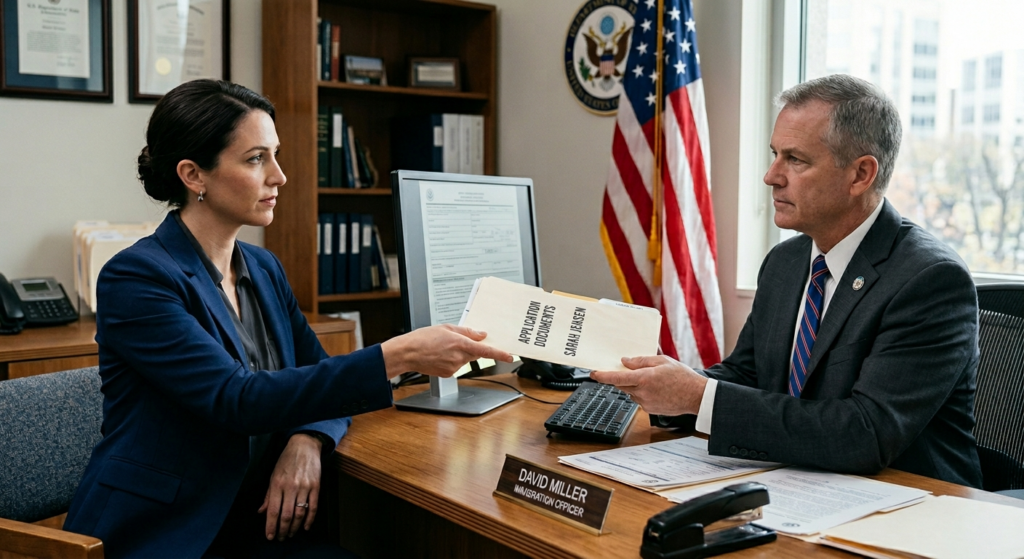
The interview is usually the most nerve-wracking part, but knowing what to expect helps a lot. Here’s the breakdown:
- Who Gets Interviewed: In an adjustment of status case, USCIS typically requires all applicants (the principal applicant and any dependents) to be interviewed. In consular processing, you (and any family applying with you) will interview at the embassy or consulate. (Note: some categories can skip the USCIS interview – for example, certain employment-based applicants with recent medical exams may get an interview waiver, or children under 14 often don’t interview. But marriage-based, for instance, almost always does have an interview.)
- Interview Notice: You’ll receive an interview appointment notice in the mail well in advance of the date. It will list the documents you must bring. Read it carefully. Common required documents include: appointment notice, passports, current visa, I-94 card (if in U.S.), original birth certificates and marriage certificate (with certified translations if not in English), any court records or police reports, previous passports or travel docs, and proof of the qualifying relationship (like photos, joint lease, correspondence for a spouse’s case).
- What to Expect at USCIS (AOS): The officer will usually start by reviewing your file and confirming identity. They might go question by question through the forms you filed, checking that everything is accurate (name spellings, dates, address history, etc.). For family cases, they will ask personal questions to verify the marriage or family relationship is genuine (for a marriage green card, they might ask how you met your spouse, details about wedding, daily routines, etc.). For employment cases, they may confirm your job duties and background. They may also ask about any criminal history, prior immigration violations, or other red-flag issues (so be honest!). The tone is usually formal but friendly. It can take anywhere from 5 minutes (for an easy case with no issues) to an hour (for complicated cases or interviewing multiple people).
At the end, the officer often says whether your case seems approved or if they need more evidence. But sometimes you wait for mail even after the interview. - What to Expect at the Embassy (Consular Interview): The consulate interview is similar in spirit but with a consular officer instead. They will review your immigrant visa application, ask about your background and petition, check documents, and make sure you’re admissible. Often it’s shorter and focused on authenticity of documents and eligibility. If everything is fine, they approve the visa on the spot (though it still might take a few days to prepare your passport with the visa).
- No-Show or Interview Waiver: Don’t miss the interview – if you do, USCIS/embassy could deny your case. There are rare cases of interview waivers (for example, children under 14 or certain employment categories). If USCIS waives your interview, they will usually send an approval notice or request medical exam results instead.
The key to a good interview: be prepared, bring what they ask for, and answer clearly and truthfully. It’s not a test – it’s just an opportunity for the government to double-check that you qualify. Think of it like meeting an official who needs to confirm your paperwork, rather than a daunting exam.
How Will I Receive the Decision on My Green Card Application?
After all the steps above, USCIS (or the consulate) will make a decision. Here’s how you’ll find out and what can happen:
- Notification: USCIS will always send written notices. Typically, you first get a receipt notice when you file (Form I-797C), and you may get other notices (like an RFE, if more info is needed). Finally, you’ll get an approval or denial notice (Form I-797) mailed to your address. If you have an online account with USCIS (highly recommended), you can also check your case status online on the USCIS case status page and sign up for email/text alerts.
- Approval: If USCIS approves your adjustment of status, you will soon receive your actual green card (Permanent Resident Card) by mail (usually within 2-4 weeks after approval, though times can vary). The notice might say something like “We have approved your Form I-485” and then mail you the card. If you did consular processing, approval comes as an immigrant visa in your passport. You then use that visa to enter the U.S., and the green card is mailed to your U.S. address (or given at the port of entry as an I-551 stamp, to be followed by the card in mail). Congratulations – at that point you are a lawful permanent resident!
- Request for Evidence (RFE): If USCIS feels they need more information to decide, they’ll issue a Request for Evidence. An RFE will list what documents or proof you need to provide and give you a deadline (often 87 days). This pauses the adjudication of your case. Respond carefully and completely, because delays add up. (For instance, CitizenPath notes that an RFE can add three to five months to your timeline.) If you miss the RFE deadline, your case could be denied.
- Notice of Intent to Deny (NOID): This is less common, but if USCIS believes your application should be denied (for serious issues), they may send a NOID giving you a short time (30 days) to respond before a denial. A NOID is a warning that denial is coming. Like an RFE, you must address every point, or the outcome will almost certainly be denial.
- Denial: If USCIS denies your application outright (no RFE), you will get a denial notice explaining the reasons and whether you can appeal or file a motion to reopen. If you do nothing after denial (or miss deadlines), the case is over and you’re back to your prior status (if any), which could have serious consequences. Denials happen if applicants don’t qualify, don’t respond properly, or have ineligibilities (like certain criminal issues).
- Processing Times: How long until the decision? That varies. Adjustment of status applications commonly take around 10 to 13 months on average for family cases(though some are faster or slower). Employment-based cases can take longer if your visa category isn’t immediately available. Processing times also depend on which USCIS office or service center handles your case and how busy they are. You can always check the USCIS website’s Case Processing Times page for the specific form and location. For consular processing, the wait includes the I-130 petition time plus visa interview wait time, often around 6–12 months or more, depending on the country and visa category.
No matter what happens, USCIS will communicate in writing. For peace of mind, keep your address updated with USCIS (Form AR-11) so you don’t miss any notices. And once you receive your card, double-check all the info on it (name spelling, birth date, etc.) and report any errors immediately.
Final Thoughts
Applying for a green card is a big process, but remember: one step at a time. From choosing the right pathway and filing the petition, through the biometrics and interview, to finally getting that approval – each stage is manageable. It can take months or sometimes years, so it really pays to stay organized (keep copies of your receipts and forms) and respond promptly to any USCIS requests. Mistakes or delays usually come from missing deadlines or incomplete documentation, so double-check everything you send.
Emotionally, it’s normal to feel anxious or excited. This is likely one of the most important journeys of your life, aiming for permanent residence in the U.S. Lean on your support system, and don’t hesitate to ask questions (to an attorney or accredited advisor) if something is confusing. Remember, success favors the prepared, so gather the right documents, practice for your interview, and keep track of your status online.
Above all, keep your eyes on the goal. A green card means stability and opportunity, it’s worth the effort. Each day brings you closer to that card in your hand. Take a deep breath, trust the process, and keep moving forward. The team at The Law Offices of Anne Z. Sedki has helped many people through this, and we’ll be rooting for you every step of the way.
(Disclaimer: This blog is for general information only and does not constitute legal advice. Immigration rules are complex and change over time. For advice about your specific situation, consult a qualified immigration attorney.)
The Law Offices of Anne Z. Sedki
Deciding to apply for a U.S. green card can feel overwhelming but you don’t have to do it alone. Our experienced immigration lawyers know all the ins and outs of these processes. We’ve guided many families and professionals to achieve permanent residency, and we’d be honored to help you too.
If you have questions about which category fits you, need help with forms or preparing for an interview, or simply want peace of mind, reach out to us today. A personalized consultation with our firm can clarify your path, identify any potential issues, and set you up for success. There’s no substitute for expert guidance in these matters.
At The Law Offices of Anne Z. Sedki, we provide practical, step-by-step support to make your green card journey as smooth as possible. We can review your documents, communicate with USCIS on your behalf, and ensure nothing slips through the cracks.
Many clients have told us how much easier they breathe knowing we’re handling the legal details. So if you’re ready to take the next step or simply want advice on the way, give us a call or send us a message. Your future in the United States is important, make sure you have the right team beside you.
Let’s work together to make your American dream a reality.