
The Department of Labor (DOL) has announced a proposed rule to sharply raise the prevailing wage requirements for H-1B and permanent labor certification (PERM) visa programs.
Under the proposal (published March 27, 2026), all four wage tiers used in H-1B, H-1B1, E-3, and EB-2/EB-3 (PERM) cases would increase substantially.
By increasing the wage floors, the Department aims to reduce incentives to underpay foreign hires and curb abuse of the visa programs.
Why Is DOL Proposing an Increase?
- Protect American workers: DOL emphasizes that the existing wage levels are often well below what U.S. workers earn in the same roles. The proposed higher wages would help ensure that hiring foreign workers does not put downward pressure on U.S. salaries. As the Department stated, the goal is to “curb abuse” of the H-1B and PERM programs by eliminating the economic incentive to replace U.S. workers with lower-paid visa holders. In other words, foreign workers should be paid at least on par with similarly skilled American workers.
- Strengthen program integrity: The revision is also aimed at improving the integrity of the visa programs. DOL explains that it wants to “strengthen program integrity by reducing the incentive for employers to use these programs to replace, rather than supplement, U.S. workers”. In practice, this means raising the required wages at each level so that employers cannot circumvent hiring Americans simply by paying below-market wages.
- Consistent with prior efforts: This initiative is not entirely new. The Trump Administration had signaled support for higher prevailing wages during its first term in office, and DOL’s current leadership echoes that commitment. In the March 2026 press release, the Secretary of Labor explicitly said the Trump Administration is “committed to ensuring that American workers are not disadvantaged by unfair wage practices”. Additionally, this proposal comes on the heels of other policy changes to deter low-wage H-1B hiring – for example, a late-2025 presidential proclamation imposed a new $100,000 fee on certain H-1B visa petitions filed from abroad. Taken together, these steps reflect a broader push to prioritize higher-skilled, better-paid foreign hires and protect U.S. workers’ wages.
Comparison of Current and Proposed Wage Levels
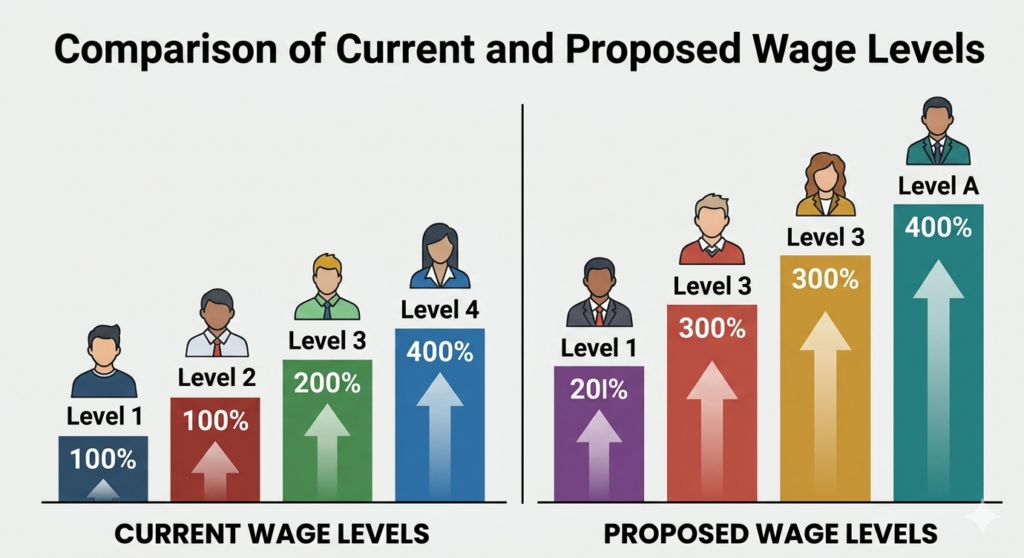
DOL’s four-tier prevailing wage system is based on The Bureau of Labor Statistics (BLS) data. Under the proposal, each tier’s wage floor would correspond to a higher percentile of the local wage distribution. The table below illustrates the change (using 2020–2024 data as an example):
| Wage Level | Current OEWS Percentile | Proposed OEWS Percentile |
| Level 1 (Entry) | 17th percentile (~$73,279) | 34th percentile (~$97,746) |
| Level 2 (Qualified) | 34th percentile (~$98,987) | 52nd percentile (~$123,212) |
| Level 3 (Experienced) | 50th percentile | 70th percentile |
| Level 4 (Fully Competent) | 67th percentile | 88th percentile |
This change would generally mean about a 20–33% increase in the wage floor for each level (larger increases at the lower levels). Note that the exact dollar amounts will vary by occupation and location based on the BLS occupational wage data.
Which Visa Categories Are Affected?
The proposed rule covers both temporary and permanent labor visas. Specifically, it applies to:
- H-1B, H-1B1, and E-3 visas: Temporary visas for specialty occupation workers (H-1B), Chilean/Singaporean professionals (H-1B1), and Australian professionals (E-3). All Labor Condition Applications (LCAs) for these visas would use the new wage levels.
- PERM (EB-2 and EB-3) labor certifications: Permanent (green card) employment visas in the second and third preference categories. Employers seeking a labor certification for EB-2 or EB-3 workers must pay at least the prevailing wage, so the PERM process will also adopt the new wage tiers.
These programs are explicitly listed in DOL’s proposal, which states that the changes apply to “PERM […] or through H-1B, H-1B1, or E-3 nonimmigrant visas”.
How Does DOL Determine Prevailing Wages?
DOL uses a standardized methodology based on BLS data. Under current rules, DOL assigns each job to one of four wage levels. These levels are defined by percentiles of the Occupational Employment and Wage Statistics (OEWS) survey for the occupation and geographic area.
For example, currently Level 1 is the 17th percentile of the wage distribution, Level 2 is the 34th, Level 3 the 50th (median), and Level 4 the 67th.
The new proposal would use higher percentiles for each level, as shown above. DOL would continue to rely on the OEWS survey and the four-tier framework, but with new percentile cutoffs. (Employers have some flexibility: they may use certain private wage surveys in limited cases, but those surveys are typically more expensive and generally yield wages about 20% above OEWS levels.)
In all cases, the prevailing wage serves as a floor: employers must offer at least that wage and attest they will pay it. DOL’s press materials note that the updated methodology uses “statistically grounded percentile thresholds” from the OEWS survey to align wages with those of U.S. workers.
When Will the Change Take Effect?
Because this is a proposed rule (Notice of Proposed Rulemaking), it is not yet in force. DOL published the NPRM on March 27, 2026, and has set a 60-day public comment period (comments due May 26, 2026).
If finalized, the rule would become effective on a date specified in the final publication (typically 60 days after finalization).
DOL indicates that the new wage methodology would be applied prospectively. That means only new LCAs and PERM applications filed after the effective date would use the higher wages. Existing certified LCAs or pending visas would remain under the old levels.
The NPRM makes it clear that employers will be given time to adjust: applying the new wages prospectively “affords employers the necessary latitude they need to adjust their business needs accordingly”.
Next Steps for Employers

- Review and comment: Employers and stakeholders should review the proposed rule in detail. The Federal Register notice and DOL’s fact sheet are available on regulations.gov (Docket ETA-2026-0001). Comments can be submitted through May 26, 2026. If you have concerns (for example, about impact on small businesses), you may comment during the rulemaking.
- Plan for higher wages: Even before the rule is final, begin estimating how higher wage floors would affect your hiring costs. Compare your current offered wages (for H-1B or green card positions) to the proposed levels above. Plan how you would increase salaries to meet Level 1–4 as needed.
- Adjust budgeting: Higher wages mean higher visa costs (and potentially more lottery entries under the new wage-weighted lottery). Employers should update budgets and compensation plans accordingly.
- Prepare PERM and LCA filings: Once (if) the rule is final, all new LCAs and PERM applications must meet the higher wage requirements. Employers planning green card sponsorships should be aware that the wage offered in PERM must meet the new prevailing wage.
- Monitor related policies: This change comes alongside other recent H-1B reforms. For example, USCIS has implemented a wage-based lottery system and a new $100,000 filing fee on certain H-1B petitions. Employers should stay informed on all such developments, as they collectively affect hiring strategy.
- Consult experts if needed: Especially for employers with frequent H-1B or PERM filings, it may be wise to consult immigration counsel or HR advisors. They can help interpret the final rule, model costs, and ensure compliance once the new levels take effect.
In essence, the proposal signals that the government expects foreign workers to be paid closer to what U.S. workers earn in the same jobs. Any employer who plans to use H-1B or PERM programs should prepare now by reviewing wages and workforce plans.
Conclusion
The DOL’s proposed wage rule represents a major shift in H-1B and permanent labor certification policy. By boosting the prevailing wage floors, the Department seeks to protect U.S. workers and close loopholes that allow low-ball wages for foreign hires.
This change (if adopted) would help ensure foreign-skilled workers compete on a more level playing field and would reinforce the integrity of the visa programs.
Affected employers must watch the comment process and be ready to meet the higher wage requirements for future filings. While this proposal does not alter visa quotas or other eligibility rules, it does mark a significant increase in the cost of bringing in foreign professional talent.
The Law Offices of Anne Z. Sedki
The Law Offices of Anne Z. Sedki assists employers and individuals with all immigration and employment-based visa matters.
Our attorneys have deep experience with H-1B, PERM, and EB-2/EB-3 processes. If your business relies on hiring foreign workers, or if you need guidance on prevailing wage compliance, we can help.
We advise on preparing Labor Condition Applications and labor certification petitions, and we stay current on regulatory changes like this proposed rule.
Contact us for a consultation – we’ll review your situation and ensure you understand and are ready for the new requirements.